Showing posts with label Information Management. Show all posts

Sunday, January 5, 2025

Unlocking the Future of Information Management: Highlights from the LIAZ Training Workshop

By the Library and Information Association of Zambia

Workshop participants
In an era where information is the cornerstone of success, the Library and Information Association of
Zambia (LIAZ) made significant strides in empowering professionals with its transformative training workshop held in Kabwe from 10 to 13 December 2024. Themed “Information Management: A Strategic Tool for Organizational Success,” the event attracted 105 professionals, academics, and practitioners, all eager to gain knowledge and unlock new possibilities in the future of information management.

The workshop offered an immersive learning experience under the guidance of two seasoned trainers, Mr. Sitali Wamundila and Dr Clement Kasenge. Together, they guided participants through topics such as information management, information governance and security, and knowledge sharing and accessibility, providing a comprehensive exploration of the field's core concepts.

Workshop sessions 

The session on Introduction to Information Organizations, led by Mr. Sitali Wamundila, highlighted the critical role of governance and leadership in driving the success of information organizations. Participants gained valuable insights into how visionary leadership can transform information organizations into centres of innovation and productivity.

Training in session
In the Skills for Excellence in Information Management session, also facilitated by Mr. Wamundila, participants explored strategies for embracing digital transformation. They were provided with tools and techniques to develop capacities and enhance organizational information processes.

Another session led by Mr. Wamundila, titled Governance and Security, focused on developing robust governance frameworks and emphasized the importance of managing information security risks in today’s data-driven world.

Dr Clement Kasenge, in the Foundations of Information Management session, introduced participants to the information management value chain, providing a comprehensive framework for addressing organizational information needs and implementing effective auditing practices.

In his second session on Knowledge Sharing and Accessibility, Dr. Kasenge guided participants in exploring the importance of collaboration and breaking down barriers to information sharing. Attendees engaged with practical tools and strategies to cultivate a culture of inclusivity and shared learning within their organizations.

Interactive Learning Beyond Theory

The workshop extended beyond theoretical discussions, featuring interactive sessions, case studies, and networking opportunities. Participants collaborated actively to design actionable plans that could be implemented immediately within their organizations, ensuring the training’s impact stretched far beyond the conference walls.
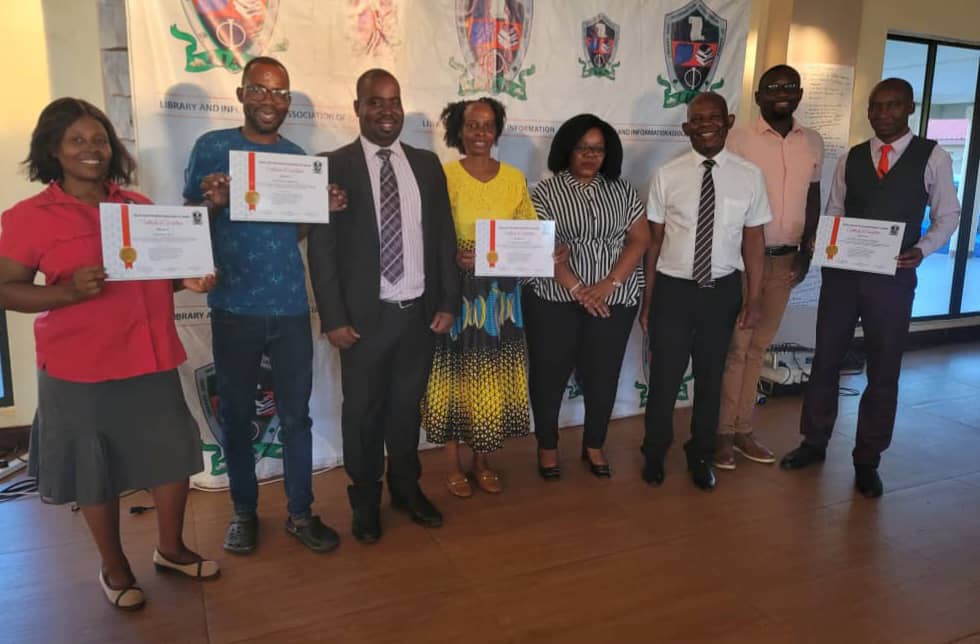
Resource persons and some participants
Lasting Impact and Looking Forward

By the end of the training workshop, attendees' enthusiasm reflected their deeper understanding of information governance, enhanced practical skills, and renewed commitment to fostering innovation within their organizations. This vibrant energy underscores LIAZ’s dedication to empowering professionals and solidifying its position as a leader in information management, both in Zambia and beyond.

Tuesday, January 16, 2024

Elevating professionalism: LIAZ's information management training workshop for librarians, registry, and records personnel

LIAZ workshop participants at
 the M'kango Golf View Hotel in Lusaka, Zambia
In a bid to enhance professionalism in libraries, registries, and record centers, the Library and Information Association of Zambia (LIAZ) recently organized a comprehensive Information Management Training workshop under the theme: “Enhancing professionalism in Libraries, Registries and Record Centers through ethical conduct, confidentiality, transparency, skills development and capacity building”. The workshop was held from the 4th to 8th of December, 2023, at M'kango Golfview Hotel in Lusaka and it drew over 150 participants, representing all 116 councils in Zambia. 

Opening Remarks and Objectives

Ms. Pauline Namulomba Nchemba, LIAZ Vice President, set the tone by emphasizing the critical role of the workshop in preparing attendees for success. She highlighted the focus on ethical standards, confidentiality, transparency, skill enhancement, and capacity building within public libraries and registry offices. The workshop aimed to foster ethical principles, ensure confidentiality, promote transparency, enhance technological proficiency, develop customer service techniques, and instill a culture of continuous learning.

Official Opening by the Guest of Honour - Mr. Nicholas Phiri-Permanent Secretary

Mr. Nicholas Phiri, the Permanent Secretary -Technical Services
Ministry of Local Government and Rural Development
The workshop was officially opened by Mr. Nicholas Phiri, the Permanent Secretary-Technical Services, Ministry of Local Government and Rural Development. Mr. Phiri commended the initiative, stating that such training is a valuable investment intended to enhance efficiency and effectiveness in managing outcome-oriented institutions. He urged attendees to apply the lessons learned, expressing the ministry's expectation of a notable difference in the operations of libraries, registries, and the handling of confidential information.

In addition, Mr. Phiri thanked LIAZ on behalf of the ministry for their assistance in promoting and advancing the nation's national development goal. "The new dawn government is dedicated to making sure that development is achieved nationwide without leaving any region behind”. 

LIAZ President’s Commitment

Mrs. Mutinta Nabuyanda, LIAZ President
Mrs. Mutinta Nabuyanda, LIAZ President, expressed gratitude to Mr. Nicholas Phiri and reaffirmed LIAZ's commitment to capacity building. She acknowledged the collaboration with the Ministry of Local Government and highlighted LIAZ's dedication to addressing identified skill gaps through periodic skills audits.

Facilitators and Workshop Highlights

The workshop featured three facilitators: Mr. Solomon Nyirenda, Mr. Godfrey Miti, and Eng. Bornwell Luanga. They covered a range of topics, including enhancing professionalism, data protection, privacy, confidentiality, technological proficiency, record-keeping, transparency, customer service, community engagement, and professional growth.

On the first day, all the 3 facilitators gave overviews that focused on Challenges of Information Management in Public/ Private Institutions, Role of Librarians and Registry officers in Community Building and Enhancing Professionalism in Libraries, Record centers and Registry Services. On the second day, the discussion on data protection, privacy, and confidentiality was led by Eng. Bornwell Luanga. On the third day, Mr. Solomon Nyirenda covered technological proficiency, record-keeping, and transparency and on the fourth day, Mr. Godfrey Miti emphasized customer service, community engagement, and professional growth

Closing and Certification

Certificates of attendance were issued to all participants on the last day of the workshop, recognizing their commitment to enhancing professionalism in libraries, registries, and record centers. LIAZ's Information Management Training Workshop stands as a beacon for continuous learning and development within the field, ensuring that librarians and registry officers are equipped with the necessary skills to drive positive change in their respective roles. The workshop not only contributes to individual professional growth but also aligns with the national development goals of Zambia, showcasing the pivotal role libraries play in the country's progress.


Friday, December 6, 2013

Digital agriculture information management in ECOWAS countries

I recently organized a seminar on Agricultural Information Management and Knowledge Exchange in ECOWAS (Economic Community of West African States) countries in Akosombo, a small town in the east of Ghana in the Eastern Region and the site of the Akosombo Dam. I invited senior officers responsible for information management and dissemination functions in Ministries of Agriculture to discuss the impact and the resulting policy and strategy implications of modern information and communication technologies on agricultural information management, dissemination, and knowledge exchange in their ministries.

Workshop participants
The participants came from  Benin, Burkina Faso, Cape Verde, The Gambia, Ghana, Guinea, Guinea Bissau, Liberia, Mali, Niger, Nigeria, Senegal, Sierra Leone, and Togo. Only Côte d'Ivoire was not represented at the seminar. They included directors or officers in charge of ICT,  Archives, Libraries and Documentation, Communication and Public Relations, and Agricultural Statistics.

From the ensuing discussions it was evident that there is an absence of appropriate policies to facilitate information management and dissemination and a general lack of investments in digital agricultural information management and dissemination activities. The result is that a lot of emphasis is being placed on print-based information resources which by default are limited in circulation. In most instances very few copies of print documents are produced, mainly as grey literature, and are rarely documented making difficult to know what is available in the Ministry.

The absence of coordination among the units or departments involved in the collection, management and dissemination of information was also a major concern for some participants. They indicated that in some cases communication units and IT departments do not coordinate their activities regarding content generation for the Ministry’s web site.

The participants agreed that social media has a role to play in information dissemination and knowledge sharing. However, official use of social media tools in Ministries of Agriculture was said to be very limited. Some ministries are experimenting with social media, especially with Facebook. But without social media strategies in place, such experiments are doomed to fail.

While some Ministries of Agriculture (i.e. Ghana, Liberia, Nigeria and Senegal) have developed websites, the discussions revealed that provision of content on the websites is erratic, and is a major challenge. Most websites do not provide access to full-text documents produced by the Ministries due to the absence of policies on digital information resources dissemination. In some cases, up-loading documents to the website takes longer than necessary because of weaknesses in the internal work flows for digital content management.

Agriculture statistics graphs
from CountrySTAT
One aspect of information management that is doing quite well in the region is agricultural statistics. Countries such as Benin, Burkina Faso, Ghana, Gambia, Guinea Bissau, Niger, Nigeria, Senegal and Togo have been assisted by the Food and Agriculture Organization (FAO) to develop their capacity to provide reliable statistical data on food and agriculture, necessary to monitor national trends. This was done under the CountrySTAT initiative, and they all have websites where agricultural related statistics are publicly accessible.

If Africa is to fight poverty with information and knowledge, easy access to relevant information, such as information for agricultural and rural development, is critical. Ministries of Agriculture can easily make their information accessible if they managed and disseminated their information resources in digital information. To achieve this, they will have to put in place policies and strategies conducive for digital information management and sharing, and invest in both institutional and individual capacity development.
------
Justin Chisenga, PhD
Food and Agriculture Organization (FAO)
Regional Office for Africa
Accra, Ghana