Showing posts with label ULIA. Show all posts

Friday, May 3, 2024

Reflecting on my first SCECSAL Conference: Insights from Bosco Buruga

By Bosco Buruga, Librarian, Muni University, Uganda

It is exactly one week since the XXVI SCECSAL Conference ended in Mombasa. A truly inspiring experience of some sorts for the delegates both first-timers and regulars. The conference was a vibrant gathering of brilliant minds, each sharing their unique research findings and perspectives. We asked some delegates specifically those attending the region professional showpiece for the first time to share their insights about the conference and this is what they had to say. 

The conference was a transformative experience that allowed me to deeply appreciate the LIS landscape.

My name is Bosco Buruga, a librarian at Muni University, and an executive committee member of the Uganda Library and Information Association (ULIA) representing Northern Uganda. I would like to share some of my experiences at the SCECSAL XXVI 2024 Conference and Assembly held in Mombasa, Kenya from 22nd to 26th April, 2024. This conference was not just an event, but a transformative experience that allowed me to deeply appreciate the library and information science landscape in Eastern, Central, and Southern Africa.

Mr.Bosco Buruga presenting his paper during SCECSAL XXVI

When I learned that the 2024 SCECSAL Conference was going to be hosted by the Kenya Library Association, I saw it as a golden opportunity for me to attend the first SCECSAL Conference in my career. I immediately sprang into action, strategizing on how I could participate in this life-enriching conference. 

The first step was setting a goal for myself: to broaden my professional network and gain knowledge from the conference presentations. The second step was responding to the call for abstracts. I, along with two other colleagues, wrote an abstract and submitted it to the local conference organizing committee. I am grateful that our abstract was accepted, and we were able to submit a full paper, marking the beginning of a truly enriching journey. Our paper was Applying SWOT analysis to assess drivers and barriers of using e-resources among selected academic libraries in Uganda.

My dream of attending the SCECSAL XXVI 2024 Conference at PrideInn Paradise Beach Resort, Convention Centre & Spa Mombasa almost died because I failed to get funding from my institution to pay for conference fees, accommodation, and transport. I decided not to disappoint myself by missing the golden opportunity to attend my first SCECSAL Conference. I borrowed money and ventured into an exciting trip of about 1,700 km on the road using a bus from Arua City in northern Uganda to Mombasa, Kenya, for this important professional event of my life. It took me three days to reach Mombasa and another three days to return to Arua after the conference. Some Ugandan colleagues who flew from Mombasa arrived in Kampala before I started my journey from Mombasa to Nairobi city.

The sacrifice that I made to attend SCECSAL 2024 enabled me to achieve the following:

1. I had the rare opportunity to represent the president of the Uganda Library and Information Association (ULIA), as a SCECSAL delegate. This enabled me to attend the SCECSAL General Council Meeting. You cannot imagine my joy in representing ULIA and attending a meeting of Presidents of Library Associations in Eastern, Central and Southern Africa. The sacrifice I made was worth it because I networked and knew the leaders of the African Library Associations in person. I am happy I actively represented my country well because I made valuable submissions in the meeting.

2. The conference presentations were rich in content and aroused my desire to do more research and build collaborations and networks. I was moved by the president of the Library and Information Association of Zambia (LIAZ) 's presentation on supporting SDGs initiatives by establishing a children's information centre in a public hospital. I am reflecting on her presentation and developing a concept that will be used to source supporters and possible donors for establishing such an information centre in our regional referral hospital.

3. I was able to present my conference paper and received very good feedback from the conference participants. The positive reception has motivated me to respond in the future to other calls for abstract submission from SCECSAL and/or any other relevant professional conferences.

4. I met esteemed personalities in the profession, such as Prof. Clara Chu, Prof. Maria G. N. Musoke, Dr. Justin Chisenga, Dr. Kay Raseroka, Madam Getrude Kayanga Mulindwa, and Ms Jacinta Were. I was blessed to have tapped knowledge from these celebrated personalities in SCECSAL. May God give them more years to mentor us in the profession. 

5. I attended the Cultural Evening, which was characterised by a dancing competition from diverse African cultures and an awards ceremony. Africa is blessed with beautiful dances, but the time for the cultural evening was not enough. I was blessed with another opportunity to receive an award on behalf of Phenny Birungi (SCECSAL Presidents Award) and another for ULIA (SCECSAL Hosts Award).

Ugandan delegates performing during the cultural evening

6. Throughout the conference, I had the opportunity to attend various sessions from exhibitors, ranging from library systems or technologies to library information resources. All the sessions provided unique perspectives and valuable takeaways, making the conference enjoyable and less boring.

In a nutshell, the SCECSAL Conference 2024 was a success because I enjoyed all the aspects of the conference, ranging from paper presentations, workshop sessions, and Country SDGs reports to SCECSAL Country reports. A crucial take-home assignment is that, as a Ugandan librarian, I need to get involved in documenting and sharing my library's contribution to supporting the implementation of the SDGs. I will now be an ambassador of SDGs in my Library Association. I have already recommended the SCECSAL conference to my young colleagues in the profession because it offers them an opportunity to expand their professional network and fresh insights and perspectives that will enrich their work moving forward.

Mr. Buruga receiving an award on behalf of Phenny Birungi

I have started preparing for the SCECSAL conference of 2026, which the Library and Information Association of Zambia will host in the city of Livingstone. This is my time to visit the home of the Victoria Falls. God willing, I will have to be physically in Zambia to consolidate my established professional networks, get new ones, and participate in knowledge exchange in the SCECSAL region by presenting conference papers and listening to other presenters. God bless SCECSAL and its leadership.

Monday, January 4, 2021

ULIA mourns departure of two legendary librarians: Dr Frederick Mukungu and Mr. Sengero Lawrence

The Library and Information Science fraternity in Uganda is mourning the loss of two legendary librarians; Dr Frederick Nathaniel Mukungu and Mr. Sengero Lawrence. Dr. Mukungu, one of the longest-serving staff at Uganda Christian University (Mukono), succumbed to COVID-19 on the 1st /January 2021 at Uganda’s National Referral hospital, Mulago after a two week’s battle to the deadly virus. Dr, Mukungu, worked at UCU for about 23 years, as a University Librarian; before joining Muni University in Arua. He will be remembered as a very professional person who put the values of christianity in practice, said Dr. Sarah Kaddu, the ULIA President in a eulogising message read by ULIA Secretary General Mr. Charles Batambuze during the funeral services held at St. Philip’s and Andrew’s Cathedral, Mukono. The late Mukungu was a social, reliable, committed leader and hardworking person who served with diligence and integrity.

As a professional librarian, he served in various capacities. He started his career as a secondary school librarian of Mt St Mary's Namagunga, a college librarian of Uganda Christian University (UCU), university librarian to UCU up to 2015. Dr. Mukungu also vigorously supported a lot of initiatives such as the start of the Bachelor of Library & Information Science Programme of Uganda Christian university, a programme which has benefitted many students. He has supported the Library Association to host the Standing Conferences of East, Central, and Southern Africa Librarians twice. The most recent one being in 2018. Mr Charles Batanmuze noted that “a man's reputation goes ahead of him. His reputation of reliability, integrity and hard work earned him respect”.  This was true of Dr. Mukungu, Batambuze told mourners. Dr Mukunku had just served a contract with Muni University where he has been the founding University Librarian retiring in November 2020.

Mr. Batambuze noted that many young librarians have been nurtured by Dr Mukungu. He has been such a great pillar of professionalism in Uganda and beyond. We will surely miss him. The Uganda Library & Information Association (ULIA) has benefited from the leadership of Dr Mukungu when he served the General Secretary from 1998 to 2001. Dr Mukungu was also a founding member and the inaugural Chairperson of Consortium of Uganda University Libraries (CUUL) from 2001 to 2003. He will be remembered for his commitment and dedication towards the inauguration of one of the most powerful academic library consortia on the African Continent. He was so instrumental in the design of the CUUL structures. He was also one time, a treasurer - Standing Conference of National and University Libraries in East, Central and South - SCANUL ECS from 2002 to 2004. The LIS fraternity will forever be inspired by the leadership qualities that Dr Mukungu possessed.

Hardly after a day, another LIS legend in Uganda Mr Sengero Lawrence passed on. The late Sengero was one of the great lights of librarianship at the Institute of Teacher Education (ITEK) now Kyambogo University. He passed away peacefully in his sleep on the 2nd of January 2021. He will be remembered for working with others to start a Diploma in Library and Information Science program at Kyambogo University which continues to train key Library & Information Science Professionals in the East African region. Like Dr Mukungu, Mr Sengero also served as Secretary of ULIA in the 1990s when Uganda hosted SCECSAL. 

Mr. Sengero was laid to rest on the 3rd of January 2021 at his ancestral ground in Lugazi while Dr Mukungu will be laid to rest today Monday 4th January 2021 in Luzinga, Jinja district. 

May the souls of our fallen friends rest in peace. 


The late Dr. Mukungu


The late Sengero Lawrence


Sunday, April 29, 2018

SCECSAL 23rd ends as Namibians steal the show on final day

The 23rd SCECSAL Conference came to a close on Friday 27th April, 2018 at the Imperial Resort Beach Hotel, Entebbe.

The five day event that started on 23rd April was the third time the Uganda Library and Information Association (ULIA) was hosting the regional event, having hosted the event in 1990 and 2004.

Speaking at  the closing ceremony, SCECSAL President Dr. John Paul Anbu, conveyed his sincere appreciation to the hosts ULIA and the National Organizing Committee (NOC), the delegates and all sponsors who made the 23rd Conference a success. Dr Anbu was speaking for the last time as SCECSAL President before handing over the office to Dr Sarah Kaddu of Uganda.

The last day started off with three expert panel discussions which were well attended by delegates. More than 200 delegates from fifteen Library associations in Africa and beyond attended the Conference. 
Dr Sarah Kaddu and Dr John Paul Anbu
during the SCECSAL General Assembly
In her closing remarks, ULIA President Dr Sarah Kaddu thanked everyone for making the 23rd SCECSAL conference a great success. She noted that the process of managing the SCECSAL conference  had been long and challenging not mentioning demanding physical, material, financial, spiritual and emotional support.

The conference theme: “Positioning library and information services to achieve sustainable development: innovations and partnerships” was thoroughly addressed through pre-conference  workshops, paper presentations, session discussions, poster sessions and expert panel discussions. Fifteen sub-themes  were cross examined through fifty papers, workshop sessions and three Expert panel discussion sessions.

Between conference sessions, the SCECSAL General Council  meetings were held in which key decisions ware made including adopting the guidelines for establishing a permanent SCECSAL Secretariat and the and agreeing on the revised SCECSAL constitution to be adopted in the next coming months.  
Team Namibian delgetation chanting to victory
Worth noting is that issues of library and information services contribution to the attainment of sustainable development were debated in and out.  It is hoped that through the deliberations and resolutions made, the world in general and the SCECSAL region in particular should be a better place for all to live in without any one being left behind said Dr Kaddu who is also the new SCECSAL President.

Dr Chiku Mnubi Mchombu was the winner of the best SCECSAL 2018 paper award with her paper entitled "Access to information and Services by students with disabilities: A case study of the University of Namibia’’.  In a related development, Dr. Mchombu led her Namibian counterparts to confirm Namibia's readiness to host the 2020 SCECSAL conference in Namibia.

Clad in Namibian colors and waving national flags, the Namibian delegation matched through Ziba Conference Hall chanting a famous Namibian song of victory.

Dr John Paul also declared that the Library and Information Association of South Africa (LIASA) would hots the 2002 SCECSAL Conference in South Africa.

On behalf of ULIA and SCECSAL 2018 National Organizing Committee, we want to thank everyone who supported us and made this conference a success.

See you again in Namibia in 2020 at the XXIVth SCECSAL Conference! 


Friday, April 27, 2018

Hosts ULIA emerge winner of SCECSAL 2018 cultural evening dance competition

Participants from Namibia
Uganda Library and Information Associations and Institutions (ULIA) on Wednesday 25th April won the 2018 SCECSAL Cultural Evening dance competitions held at the Imperial Botanical Gardens, in Entebbe, Uganda.

A total of fifteen library Associations from the SCECSAL region and beyond participated in the cultural dance event. 

Like two years ago, the reigning champions Lesotho were represented by a lone performer but this time round, his antics were not enough to scoop the award for the second time in a row.

Among the notable participants in the dance were library and information professionals from Nigeria, Ghana and the Netherlands. 

SCECSAL 2020 hosts Namibia put up a stunning performance no wonder they finished second while the Kenyans made a sensational appearance on the stage.

Participants from South Africa
Meanwhile South Africa did not disappoint as usual as the Mr Mandla Ntombela led team excited the crowds.

The cultural evening was proceeded by three different excursions to Namugogo Shrines, Equator, Crocodile Village and the Source of the Nile. 

Friday, April 20, 2018

ULIA hosts 2018 IFLA Africa Section Mid Term Meeting

As you may be aware, it is only 2 days to XXIII SCECSAL in Entebbe Uganda. There are two pre-conferences: SCANUL- ECS and the IFLA Africa Section mid-term meeting.
It is with great pleasure that ULIA is hosting the 2018 IFLA Two Day Mid Term Meeting in partnership with Makerere University Library. 

This meeting has been graced by Prof. Tonny Oyana, the Principal of the College of Computing and Information Sciences- who welcomed the members of the IFLA Africa section to Makerere University. He noted and appreciated the role of Libraries in access to knowledge and information. He proposed that IFLA should encourage Librarians to create oral corners in the Libraries where people will go and be able to tell their stories. He also advised libraries to have a collection of maps as well as introducing virtual libraries whereby people can access information using mobile telephones.
Dr. Helen Byamugisha, the Ag. Makerere University Librarian equally welcomed the guests to Makerere University and especially to the Library.  She observed that Makerere University Library was privileged to have some of the Library staff attend the meeting as observers and interact with IFLA Africa Section committee members. 

IFLA's Manager of Development Programmes, Ingrid Bon is in attendance and she is a panelist on Expert Panel Discussion 2 during the SCECSAL  conference: "Contributions to SDGs in the SCECSAL region on 27th April. This discussion will reflect on strategies to enhance LIS contributions for the attainment of the UN 2030 Agenda and its Sustainable Development Goals (SDGs) in the region.

Don’t miss the second pre-conference SCANUL-ECS due for Sunday 22nd April at Imperial Golf View Hotel, Entebbe. 

Tuesday, April 17, 2018

Important Information for XXIII SCECSAL Delegates

Final Programme
The National Organsing Committee (NOC) XXIII SCECSAL 2018 is proud to announce the release of the final conference programme for the XXIII SCECSAL  due in Entebbe next week.  Over fifty library and information experts are expected to present papers and posters as well as participate in the expert panel discussions at the conference. You can now find a copy of the final program on the ULIA and SCECSAL websites. 

Weather in Entebbe and Uganda
The country is currently experiencing heavy rainfall and the weather is expected to be more cloudy than sunny for the next three weeks. You are kindly advised to carry less light clothes and more heavy clothes especially for outdoor activities like cultural gala, excursions and evening walks. Entebbe is very cold at night because of the great Lake Victoria. 

Visas
By now, delegates should have applied and received their visas or about to receive them for delegates who are required to have Ugandan visas before boarding the plane. Those who are eligible to obtaining visas on arrival should ensure that they possess the necessary paperwork to allow them enter Uganda. These include a valid passport, yellow fever vaccination card, return air ticket, invitation letter from ULIA, proof of residence (Hotel Booking) extra. These may vary according on your country of origin but you are strongly advised to carry along all and others. 

Cultural evening and related events
The cultural evening is the opportunity given to showcase cultural presentations from the participating countries. Every country is invited to present  a 5 minutes performance giving a sample of their culture (dance, song, etc.). We take your attention on the timing due to the quantity of countries performing. Delegates are advised to come well prepared with their traditional presentations. Come fired up to challenge the reigning champion Lesotho. 
The hosts have organized a number of tours for delegates on Wednesday, 25 April 2018. The tours, classified into two categories, will include visits to the Namugongo Martrys' Shrines, Uganda Museum and Buganda Kingdom Kasubi tombs, all under Category I; and to the Source of the Nile and Sezibwa Falls and the Crocodile Village – Buwam, under Category II. The cost per person, to be paid to ULIA, is US$20 for Category I tours and US$40 for Category II. Conference delegates planning to go on any of the tours should indicate their preference to secretariat@ulia.org.ug not later than 20 April 2018.

SCANUL-ECS 2018 Pre conference 
The customary pre- conference is co-hosted by NLU and CUUL. The hosts are working in close partnership with the organizers of the Twenty-Third Standing Conference of Eastern, Central and Southern African Library and Information Associations (SCECSAL XXIII). SCANUL-ECS will be held on Sunday 22nd April at Imperial Golf View Hotel, Entebbe. The pre-conference will ride on the theme: Positioning National and University Libraries to Achieve the Sustainable Development Goals (SDGs).  The delegates’ fee for this pre-conference is 50USD per delegate.  Contact haumban@gmail.com, or akatungisa@yahoo.com/akutungisa@nlu.go.ug for details of this pre-conference. 
N.B. The fees (50 USD) paid at the SCANUL-ECS are NOT in any way part of the fees paid for SCECSAL. 
      
Culture and Atmosphere around Entebbe
Entebbe is a town on a peninsula in Lake Victoria, in Central Uganda about 38 kilometers away from the capital city. The town is relatively quiet during the day and extremely quite during the night save for the sporadic echoes of aircrafts landing and taking off from the main airport in the area.  The area is endowed with busy beaches and  so many gorgeous features to view as well as the lakeside Uganda Wildlife Education Centre which protects native animals in wetlands, forest and savanna habitats. Nearby, Entebbe Botanical Garden has diverse plants, birds and monkeys. Also close by is the Ngamba Island Chimpanzee Sanctuary, which protects orphaned chimps. Come ready to view all the above and more. Entebbe has a pleasant climate for you to enjoy – it is on Lake Victoria and you can reach various choice destinations from here, most of them a short drive, or boat ride, now even  by plane or helicopter.  Don’t miss out on what Entebbe and the surrounding area has to offer .

Power Sockets
In Uganda, type G sockets are used for electricity connections. They are commonly and cheaply available on the local market.  The standard voltage in Uganda is 240 V and the frequency is 50 Hz. You can use your electric appliances in Uganda, if the standard voltage in your country is in between 220 - 240 V.

Airport pickups and Mode of transport. 
Our visitors who will safari Uganda have got variety of transport means which you can use when you are in the country. These include local motorcycle transporters  commonly known as “Boda-Boda”, Commuter Taxis, Special Hire vehicles, passenger buses and Uber. Foreign  delegates are advised to seek advice from their local counterparts on which mode of transport to use while in Uganda. Boda Bodas are fun to use and explore but you are highly advised to use it only if you are wearing a head gear (Helmet). 

Food. 
Meat or chicken stews are popular in Uganda served with rice, chapatti, ugali (a stiff maize porridge) or matoke (a cooked plantain/banana mash). For a sweet dish, locals enjoy a type of doughnut called mandazi. With Uganda's many lakes and rivers, fish are an important food. However, almost all the hotels in Uganda offer continental cuisines ranging from 5 to 20 USD.

Airport Pick and Drop
The Organizers of SCECSAL 2018 are offering complementary airport pick and drop for delegates arriving from 21st of April before 10 pm. Delegates who are interested in this service should send their flight details to Mr. Jospert Chelangat email: jochelangat@gmail.com and hotel of  residence. Most hotels offer complimentary pick and drop. Find out from the hotel you booked or else, give us your itinerary and we shall pick you from the airport upon arrival. A team of volunteers and officials will be stationed at the Airport Arrival Terminal with the huge Poster marked “SCECSAL 2018”. Kindly introduce yourself to that team on arrival at Entebbe International Airport and they will give you the necessary assistance.

On behalf of ULIA and the SCECSAL 2018 National Organizing Committee, we look forward to warmly receiving you in Uganda, the Pearl of Africa. . 

Tuesday, February 27, 2018

Preliminary programme for XXIII SCECSAL conference is out

The Uganda Library and Information Association (ULIA), host for the forthcoming XXIII SCECSAL conference, has published the preliminary programme for the conference.

The 2018 conference, to be held from 23 to 27 April, in Entebbe, Uganda, will be a mixture of paper presentations in plenary and parallel sessions, workshops, expert panel discussions and excursions.

ULIA has scheduled keynote addresses and they include an address by Mr. Augustine Omare-Okurut on Positioning LIS to Achieve SDGs; Dr. Shana Ponelis who will speak on Broadening Innovations in LIS Education; and Dr. Cornelius Gulere on Whose access? Whose tools? Whose information? Creative LIS Partnerships to achieve SDGs.

Several sessions on different themes are also planned during the five-day event including on SDGs and Libraries and Information Services in the SCECSAL Region; Open Science, Open Data and LIS and SDGs; ICTs and Library and Information Services; Effective Records Management to Fight Corruption, and Library and Information Services to Improve Health Care, among others.

Three Expert Panel discussions are included on the programme and will focus on the following topics:
  • Is there a gap between LIS education and practice in the SCECSAL region? 
  • Contributions to SDGs in the SCECSAL region: are LIS institutions and professionals on the right track? 
  • Marakesh Treaty and its impact on access to information by persons with disabilities
Departing away from the normal practice of holding SCECSAL Council Business Meetings on the last day of the conference, the 2018 Council meeting will be a pre-conference event on 22 April, an arrangement that will ensure that the Council has enough time to discuss all the agenda items.

Wednesday, 25 April is reserved for excursions during the day and a Cultural Event in evening at which the SCECSAL Author of the Year and SCECSAL Excellence Awards be given.

Thursday, February 1, 2018

Early Bird Registration Deadline Extended

The SCECSAL 2018 National Organising Committee (NOC) is pleased to inform all the prospective delegates, participants, paper presenters, Exhibitors and the entire LIS fraternity across the region and globally that the deadline for early bird registration has been extended to Wednesday 14th February 2018. Take advantage of the deadline extension to register and pay 360 US Dollars.

To register for the conference, visit http://www.ulia.org.ug/ and select the “Register Online” option in the SCECSAL@40 flashing simulation. 

Delegates, Paper Presenters and Exhibitors who require SCECSAL invoices to process funding at their respective Institutions are kindly advised to contact SCECSAL 2018 Treasurer Miss Sarah Kagoda-Butuwa at: sarahkago@yahoo.com. Delegates who require Invitation letters and Paper Presenters who may wish to get Acceptance Letters from the conference organisers can contact Dr Sarah Kaddu at: sarkaddu@yahoo.com, and copy cbatambuze@gmail.com, haumban@gmail.com. Those interested in accommodation information should contact Mr. Jospert Chelangat at: jochelangat@gmail.com.

Poster Presenters who haven’t submitted their posters are required to do so immediately to the Chairperson Programs and Presentations Sub-Committee  Ms Gertrude Kayaga Mulindwa at  kayaga@hotmail.com and copy to haumban@gmail.comburosta@gmail.com

Early Bird Registration (Deadline 14th February, 2018) = USD 360

Late Registration (by 31 st March 2018) = USD 400
Onsite Registration (from 24 th April 2018) = USD 430
Rental fees for Exhibition stalls (2 x 2 metres) = USD 200

On behalf of ULIA and SCECSAL 2018 NOC, we wish you fruitful preparations and we look forward to seeing you in Entebbe for SCECSAL come April 2018. 

Monday, January 15, 2018

Online registration opens for XXIII SCECSAL conference planned for 23-27 April 2018

Early bird registration closes on 31 January

The Uganda Library and Information Association (ULIA) has opened online registration for the XXIII SCECSAL conference, to be held 23-27 April 2018 in Entebbe, Uganda at the Imperial Resort Beach Hotel.

Early bird registration for the conference closes on 31 January 2018.

Below are the applicable fees for the distinct categories of registration:

  • Early Bird Registration (deadline 31st January 2018) – US$ 360
  • Late Registration (by 31st March 2018) – US$ 400
  • Onsite Registration (from 24th April 2018) – US$ 430
  • Rental fees for Exhibition stalls (2 x 2 metres) – US$ 200
Click here to register for the XXIII SCECSAL Conference.

Click here for more information about the conference, including accommodation, entry visa information, etc.

Inquiries regarding online registration should be sent to: sarahkago@yahoo.com and sarkaddu2@gmail.com.

Tuesday, January 2, 2018

Mark your 2018 calendar for the XXIIIrd SCECSAL conference in Entebbe

The Twenty-Third Standing Conference of Eastern, Central Southern African Library and Information Associations (SCECSAL) is four months away and if you have not yet made the decision to attend the event, it is now time to do so.

The biennial SCECSAL conference is the largest regional gathering of library and information professionals in Africa and the 2018 event, from 23 to 28 April, will be no different as more than 300 participants and exhibitors from within and outside the continent are expected to descend on the City of Entebbe located on the shores of Lake Victoria, Africa's largest lake.

The host, Uganda Library and Information Association (ULIA), is in addition to the normal professional programme featuring keynote speakers and paper presenters, preparing a programme that will also include social events such visits to some tourist sites in Uganda and a cultural evening at which conference participants from each country will be required to form a group and participate in a dancing competition.

The SCECSAL General Council, the highest decision-making body of the organization, will also meet during the conference and is expected to adopt the amended SCECSAL constitution, the guidelines for selecting a member Association that will host the SCECSAL permanent Secretariat, get an updated from the Namibian Information Workers Association (NIWA), host for the 2020 conference, and decide on the member Association to host the conference in 2022.

The decision to amend the constitution and establish a permanent Secretariat was made by the General Council at the XXII SCECSAL conference in Ezulwini, Swaziland in 2016 following discussions and resolutions on how to improve SCECSAL operations.

The Entebbe conference will also see the re-introduction of the SCECSAL Author of the Year awards after a 16-year absence having last been awarded at SCECSAL 2002 in Johannesburg, South Africa hosted by the Library and Information Association of South Africa (LIASA).

The call for nominations for the 2018 SCECSAL Author Awards closed on 31 December 2017.

Monday, December 18, 2017

Entebbe Mayor extends invitation to library and information professionals to XXIII SCECSAL conference

Entebbe Mayor Vincent De Paul Kayanja
Mayor of the Municipality of Entebbe Vincent De Paul Kayanja has extended an invitation to library
and information professionals to travel to Entebbe to take part in the memorable XXIII SCECSAL conference and enjoy all that the city has to offer.

Mr Kayanja extended the invitation in a letter made available to the Uganda Library and Information Association (ULIA) on Monday.

“Entebbe will have a great opportunity to host SCECSAL for the third time in Uganda when it is forty (40) years”, Mr, Kayanja wrote.

“From 23rd -28th April 2018, Entebbe will proudly exhibit her hospitality, cultural richness, beautiful beaches, Botanical gardens and wildlife”, Mr Kayanja added.

ULIA will host the SCECSAL Conference for the third time in the history of SCECSAL having previously hosted the regional event in 1990 and 2004.

The conference in 2018 is expected to attract library and information professionals from 11 active SCECSAL countries - Botswana, Kenya, Lesotho, Malawi, Namibia, South Africa, Swaziland, Tanzania, Zambia, Zimbabwe and the host country, Uganda, - in addition to participants coming from outside the SCECSAL region.

Thursday, November 16, 2017

MMU hosts ULIA’s 3rd regional workshop for IFLA International Advocacy Programme

Workshop participants 
Mountains of the Moon University (MMU) hosted the first of its kind International Advocacy Programme for all western Uganda librarians. Sponsored by IFLA, in association with ULIA (Uganda Library and Information Association), the western Uganda regional workshop rode on the theme “Role of Libraries in the Implementation of UN 2030 Agenda and SDGS”.

The third IAP workshop was held from Monday 6th to Wednesday 9th November 2017 at MMUs’ famous Saaka Main Campus, 8 Km off Fortportal town. The western university touches the quiet and tiny Lake Saaka just below the magnificent Rwenzori Mountains, offering a beautiful view of 
mountain sceneries all of which make the campus very unique. The workshop attracted thirty five participants from across the western region. Among those who addressed the participants during the colourful opening ceremony, are: Prof. John Kasenene the Principal, Mountains of the Moon University (MMU). 
Ms. Margaret Kahiika- Chairperson LC5 opening the Workshop
Professor Kasenene spoke on the “importance of advocacy, community outreach, value of librarians and the librarians’ roles in changing the mind-sets and attitudes of people. He highlighted the need to package relevant information to serve all diverse groups with the right information so that they apply it to their daily needs and supporting the realisation of the SDGS. He requested ULIA to continue effectively serving communities as one of the new areas to address if we are to impact on our society positively. Prof. Kasenene appreciated ULIA’s role in advocacy issues. 
He warned ULIA on the igger task she has to set a strong profession, “from hunters to good information citizens”. The participants were challenged by the vocal professor who had set up Kibaale Science Centre which is serving the community by providing the necessary information. 
Ms. Margaret Kahiika- Chairperson LC5 officially opened the workshop. She noted that Kabarole district is prioritizing at  least four SDGS as per needs of each community: poverty eradication, quality education, good health, water and sanitation and climate change so that they could ably account to the communities they serve on order to make reasonable impact by 2030. She further pointed out the importance of retooling librarians so that they improve the information provision to effectively impact the communities they serve. 

ULIA president Dr. Sarah Kaddu gave an overview of the IAP workshop, emphasising the importance of sustainable development as a process which requires steps to follow, facing challenges and reflecting on what went wrong and restart all over again for sustainable development; and importance of having quality leaders for quality library services provision. Kaddu, also the IFLA IAP trainer further talked about advocacy and lobbying, the advocacy planning cycle, developing an advocacy plan to support the un 2030 agenda, identifying programmes to support SDGS, facilitated the role play and writing advocacy plans to support 
                     Some participants carried along their infants
the un 2030 agenda. 

Mr. Eric Nelson Haumba, one of the beneficiaries of the IAP– talked about the UN 2030 agenda, Uganda’s vision 2040, Uganda’s national development plan and the role of libraries in the un 2030 development agenda. 

Participants praised ULIA for having chosen Kabarole district and for having imparted knowledge and skills on a very new area in library science- advocacy and having enlightened them on SDGS and what the roles of librarians could be to support development and in realisation of the un 2030 agenda and SDGS. Many were heard to say: "this is my first time to hear about SDGS. I had heard about the SDGS but i didn’t know what was involved and what roles library and information professionals could play".  Mr Hatega Emmanuel of Kisoro Community Library in Kisoro district was all smiles and praises about ULIA and IFLA. He promised to start awareness campaigns immediately on SDGS so that people in Kisoro district would know about SDGS and also promised to support the policy and political leaders with their development agendas. He added: we, the western region participants thank IFLA- the funders and assure them that their efforts and sacrifice was not in vain because we resolved to go out as very active and pragmatic ambassadors of the UN 2030 Agenda and the 17 SDGS gospel. 

Speaking after the three day workshop, the IAP workshop coordinator Ms.Winny Nekesa-Akullo noted that the workshop was very practical, a great success and she’s expecting a better ultimate IAP workshop that will be held in central Uganda between 27th -29th  of November, 2017.  At the end of the three days, participants had drafted their advocacy programmes to share with their institutions. 
Well-done ULIA.


Monday, November 13, 2017

Is there space for a Sub-Saharan Africa association for individual LIS professionals?

In 1976, C. C. Aguolu in his article “Library Associations in West Africa and the Concept of a Profession” in the Int. Lib. Rev., 8, 23-31, wrote that: “One of the main characteristics of any profession is the existence of an active professional association to protect the interests of its members, to determine the standards of education and performance expected of them and to ensure that its members truly live up to their expectations”.

Isaac Kikongo-Bukenya also indicated that the "cardinal responsibilities of library associations should be education and training to create educated and trained corps, among other responsibilities".

Do existing library and information services (LIS) associations/organizations in Sub-Saharan Africa protect the interests of LIS professionals? Do they have a say on the standards of LIS education and the performance expected of LIS professionals on the continent?

Sub-Saharan Africa has several national and regional LIS associations of which very few could be said to carry out the functions highlighted by Aguolu and Kikongo-Bukenya.

Most countries have national LIS associations and examples include the Library and Information Association of South Africa (LIASA), Nigerian Library Association (NLA), Ghana Library Association (GLA), Association des Bibliothécaires, Archivistes, Documentalistes et Muséographes du Cameroun (ABADCAM), Uganda Library and Information Association (ULIA), Kenya Library Association (KLA), Library and Information Association of Zambia (LIAZ), Association Sénégalaise des Bibliothécaires, Archivistes et Documentalistes, and many others.

Although most national LIS associations on the continent pursue several objectives, many largely carry out only one activity: organize national LIS annual general meetings, and in some cases, annual conferences.

At the sub-regional level, the Standing Conference of Eastern, Central and Southern Africa (SCECSAL), established in 1974, and the Standing of Conference of University and National Librarians of Eastern, Central and Southern Africa (SCANUL/ECS) are the two main active LIS organizations.

At the continental level, the main associations are the Association for Health Information and Libraries in Africa (AHILA) founded in Nairobi, in August 1984; the International Association of Agricultural Information Specialists - Africa Chapter (IAALD Africa), also established in Nairobi in May 2006; and the African Library and Information Associations and Institutions (AFLIA), formally launched in Pretoria, in 5 July 2013.

Membership to AfLIA, SCECSAL and SCACUL-ECS is open only to LIS institutions and organizations while membership to IAALD Africa and AHILA is largely for individual professionals.

AFLIA was established to provide a platform to discuss issues and further the cause of the library and information sector in Africa and in additions to its annual conferences, it also carries out advocacy related activities and capacity development initiatives that have recently largely focused on supporting public libraries, a matter that has received criticisms in some quarters.

While both IAALD Africa and AHILA admit individuals (personal membership) in addition to institutions/organizations, they were established more as platforms for promoting the exchange of ideas and access to information in their respective fields rather than as bodies to represent the professional interests of their members; their activities largely tend to focus on organizing annual/biennial conferences, and carrying out continuing professional development initiatives targeting their members.

SCECSAL and SCEANUL-ECS, as their full names indicate, are forums (or conferences) for enhancing cooperation among their members (institutions/organizations) and the exchange of experiences and knowledge in the library and information field.
Existing LIS professional associations and organizations rarely focus their efforts on protecting the interests of the library and information professionals, establishing or monitoring standards for LIS education and performance of the LIS professionals.

Therefore, is there space for a Sub-Saharan Africa-wide membership subscription association for individual library and information professionals? Or should the focus be on building the capacities of exiting national and regional associations to enable them to carry out the functions highlighted by Aguolu and Kikongo-Bukenya?

Saturday, November 4, 2017

UCU graduates first LIS Master’s students

Uganda Christian University (UCU), Mukono has graduated her first Master of Science in Information Science students. As the University (UCU) marked its 20th anniversary last month, 1,177 students (54% female and 46% male) received diplomas and degrees in 38 specialties at the fourth part of her eighteenth graduation ceremony. The colourful ceremony was held at her main campus in Mukono on  Friday October 27, 2017. 
The total of 10 students from the Library School graduated with Masters Degrees in Library & Information Science at the christian founded University in Mukono. Among the other master’s degrees graduating for the first time was Master of Arts in Child Development. The graduation ceremony was attended by a number of leading LIS trainers in Uganda. Among them was Professor I.M.N Kingongo Bukenya and Dr Sarah Kaddu, the ULIA President. Dr Kaddu who is also a top LIS trainer in Uganda lauded the achievement made by the University. 
Some of the graduates at the graduation ceremony
Speaking after the graduation, the hopeful Kaddu said “LIS Graduate Education is on the increase in Uganda! Kaddu further noted that a number of graduate information professionals with MSC Information Science and PhD Info science is making strong strides in Uganda. She cited an example of about fifty Master students and seven PhDs have graduated from the East African School of Library and Information Science (EASLIS), and recently, ten Masters in Library and Information Studies on the Programme of LIS, Uganda Christian University graduated”. 
This development hugely lessens the burden on Makerere Univeirty which has been the sole provider on LIS graduate Education in Uganda. In a related development, the MSC RAM (Records and Archives Management) of East African School of Library and Information Science (EASLIS), are due to graduate in January 2019.

Monday, October 30, 2017

Preparations on track for an exciting XXIII SCECSAL conference 2018

Participants urged to take advantage of early bird registration fee


Preparations for the XXIII SCECSAL Conference to be hosted by the Uganda Library and
L-R: Prof. Kikongo-Bukenya, Ms. Sarah Kagoda-Batuwa,
Mr. Haumba Eric Nelson, Mr. Robert Buwule, Mr. Justin Chisenga
and Ms. Sarah Kagoda-Batuwa [Photo: Charles Batambuze] 
Information Association (ULIA) in Entebbe from 23 to 28 April 2018 are on track.
This was made known to Mr. Justin Chisenga when he held informal consultations with some members of the SCECSAL Local Organizing Committee (LOC) last Friday in Kampala at the Makerere University.

Dr Sarah Kaddu, ULIA President, informed Mr. Chisenga that her Association had confirmed the reservation for conference facilities at the Imperial Resort Beach Hotel, conference papers were undergoing peer-reviewed process, and library and information professionals in Uganda were ready to welcome their colleagues from the SCECSAL countries and beyond.

Dr Kaddu also urged library and information professionals from around the world planning to attend the SCECSAL conference in 2018 to take advantage of the reduced early registration fee of US$360 and register by 31 January 2018, after which the fees would be US$400 for registrations between(1 February – 30 March 2018 (late registration) and US$430 for  registrations from 1 to 24 April 2018 (onsite registration).

On his part, Mr. Chisenga expressed delight at the progress made so far and urged the members of the LOC to quickly publish the preliminary conference programme to enable potential participants to plan their visit to Uganda.

“For many, decisions as when to arrive and depart from the conference city are based on the activities planned for the event, and therefore timely knowledge of what the programme would be is very important”, Mr. Chisenga told LOC members.

Also present at the meeting were Prof. Kikongo-Bukenya, a SCECSAL veteran; Ms. Sarah Kagoda-Batuwa, ULIA Treasurer; Mr. Charles Batambuze, ULIA Secretary General; Mr. Haumba Eric Nelson, LOC Member; and Mr. Robert Buwule, member of the LOC.

Monday, September 11, 2017

ULIA President sends greetings and advance welcome message to SCECSAL XXIII participants

Sarah Kaddu, PhD
President, ULIA
The President of the Uganda Library and Information Association (ULIA), Dr. Sarah Kaddu, has sent warm greetings and extended an advance warm and big welcome to library and information professionals in Eastern, Central and Southern Africa and beyond, to the SCECSAL XXIII conference to be held from the 23rd – 28th April 2018 at the Imperial Resort Beach Hotel, Entebbe, Uganda.

Dr Kaddu, in her welcome note posted on the SCECSAL website, said: “There will be colourful opening and closing ceremonies, plenary and professional sessions, exhibitions, the memorable Cultural Evening and tours to different places such as the historical Uganda Martyrs shrines in Namugongo, the Source of the Nile, the Equator, Kasubi Tombs, Uganda National Archives and other crowd pulling places of interest. The weather during the conference will be friendly. Security is assured”.

"I extend to all of you a big and warm welcome to SCECSAL XXIII, Entebbe, Uganda, 23rd – 28th April, 2018", Dr. Kaddu said.

ULIA has made significant progress in preparing for the SCECSAL XXIII conference and thus far the National Organizing Committee (NOC), headed by Prof. Okello-Obura Constant, has:

  • Selected sixty abstracts, through a blind review process, from among 131 that were submitted for consideration. 
  • Contacted authors whose abstracts were not accepted for paper presentation and highly advised them to consider presenting posters so that the region does not completely miss out on their good ideas.
  • Worked on arrangements to hold a conference composed of plenary sessions, parallel workshops, special and poster sessions as well as exhibitions of different library materials, products and equipment from different stakeholders in the library and information fields and beyond. 

Approximately 400 participants (librarians, information scientists, documentation officers, archivists, records managers, publishers, books sellers, academics, ICT innovators, literacy experts, policy makers, etc.) are expected to attend the SCECSAL XXIII conference.

Registration for the conference is now open and the registration form (in PDF) is available here.  The following are the applicable registration fees:

  • Early Bird Registration (deadline 31st January 2018) = USD 360.00 
  • Late Registration (by 31st March 2018) = USD 400.00 
  • Onsite Registration (from 24th April 2018) = USD 430.00 

Rental fees for exhibition stalls (2 x 2 square metres) are fixed at USD 200.00.

Delegates and exhibitors are strongly advised to leverage the early bird registration dates to confirm their attendance.

The organizes have identified many hotels along the Entebbe-Kampala highway that are closer to the conference venue. Among others, they include:


For detailed information about the hotels and other suitable accommodation facilities available in Entebbe town, visit Booking.com and search for Entebbe.

The NOC is advising potential delegates to the conference to visit the website of the Directorate of Citizenship and Immigration Control of the Ministry of Internal Affairs for entry visa and related information including the list of countries exempt from paying visa fees, visa fees, etc. Application for e-Visas is also available on the same website.

Further information on the conference is available on the ULIA SCECSAL XXIII conference website.

Inquiries should be sent to scecsal2018@ulia.or.ug.

Thursday, August 10, 2017

ULIA holds second IAP workshop in Northern Uganda: Excitement hits Librarians in the Region

Group photo of some of the Participants
The Uganda Library and Information Association has taken IFLA’s International Advocacy Programmee (IAP) by storm. In less than a month, the professional library body in Uganda has twice made media captions through her IAP workshops. On the 24th to 26th July 2017, ULIA held its inaugural IFLA-IAP workshop at the Uganda Christian University, Mable, and Eastern Uganda. On the 7th to 9th August, 2017, ULIA shifted her IAP sensitization guns to Gulu, far north of the country.  

The workshop was officially opened by Hon. Ojara Mapenduzi- Gulu District LC 5 Chairperson. Honorable Mapenduzi was very pleased to learn that the library fraternity was ready to support the realization of the SDGs and the UN 2030 Agenda.  

He said: “The current global development framework focuses on inclusive philosophy whereby, no one, poor or rich, should be left behind. All the SDGs will require the use of information as key to the UN 2030 Agenda and the SDGs. I am happy Uganda Library and Information Association (ULIA) is making the case for why it is important for all libraries to be central to the UN Agenda and Development. Libraries should empower citizens with choice and control over the decisions that impact their lives, their communities and their nation”. 

The Honorable further promised to work with the librarians in the Northern Uganda to implement his manifesto. He was now aware that libraries had a role to play in the attainment of the UN 2030 Agenda and the SDGs. He was also now aware that the reading culture of his people was still very poor hence the need for an active public library and a vibrant ULIA to manage this challenge.

The local politician was happy to see, the son of the soil – Prof. Constant Okello-Obura, Principal, College of Computing & Information Sciences (CoCIS) and immediate past President of ULIA, talking about development strategies of Gulu district and the role libraries could play in the UN 2030 Agenda.

Dr. Raphael Aregu- University Librarian, Gulu University and Mr. David Tibemenya, Principal Administrator, Gulu Regional Referral Hospital jointly made the welcome remarks. Dr. Sarah Kaddu, the current President of ULIA gave the overview on the IAP workshop.
Principal, Gulu Regional Referral hospital 
addressing participants


Dr. Kaddu, who is also an IAP Trainer, imparted knowledge and skills to the participants on how they could develop library programmes and align them to the National Development Agenda, Vision 2040, the Cape Town Declaration 2015 (Agenda 2063), and the Lyon Declaration 2013. Kaddu put particular emphasis on Goal 16:10 which directly speaks to the libraries and access to information. She further emphasised working with decision and policy makers towards developing library programmes that are aligned with the current development agendas within Uganda.

Currently, Northern Uganda has got a total of 30 districts, making it one of the biggest provinces in Uganda. The region is well known for the infamous civil war led by Joseph Kony. The region suffered from civil unrest since the early 1980s and this lasted for over two decades. 

Hundreds of people were killed in the rebellion against the Ugandan government, and an estimated 1.4 million people were left homeless. The war not only displaced people but also utterly destroyed northern Uganda’s social services sector including agriculture, education, transport, health and the economic base.  Programs such IAP are seen as timely and God sent for the natives. They are geared towards restoring hope and parity in the region.

Speaking after the Workshop, Mr. Steven Okurut commented: “This is God sent. As a result of this workshop, I now know the role of my public library; I can now take the duty I had declined, to brief my Area MP and my Council about the role of Moroto public library. Certainly I shall request for his full support in mobilising resources for its development and my advocacy work begins next week.’

Ms. Shilla Adyero, a Community Librarian was all praises for the workshop because many of the participants heard of ULIA for the first time. Ms Adyero and her colleagues vowed to support the ULIA programs to advocate for the library programmes and the role of her community library in disseminating information for development thereby supporting the UNESCO Agenda, 2030. 

At the end of the workshop, participants had developed the draft Advocacy programmes that they would further share with the decision and policy makers. They were particularly very grateful that ULIA was rolling out the Advocacy workshop to ALL regions of Uganda and East Africa. To them, advocacy is not one of the courses the LIS schools have considered in their curricular yet very important. They promised to initiate change in their libraries and also partner with decision makers, community leaders, policy makers and all the people who may cause change in the library services sector.

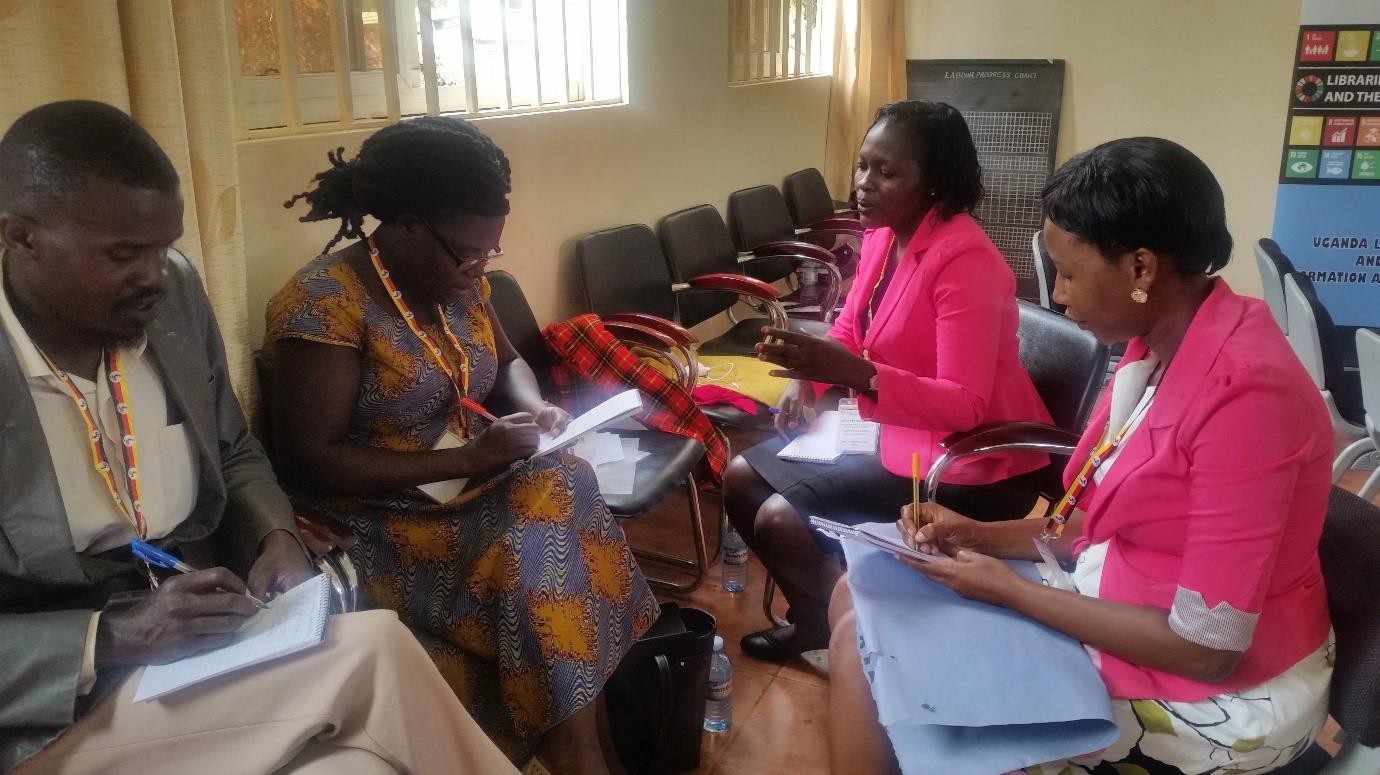
During Group Discussions
The Northern and West Nile Region IAP workshop attracted thirty two (32) Participants who came from: Gulu Regional Referral hospital, Lira University, Lutino Adunu Nwoya community library, Gulu university library, Cavendish university Gulu, Arua public library, Nebbi Municipal Council, Paidha public , one public library, NTC Unyama, Gulu SOCO, Gulu public library, Nebbi public library, Moroto public library, Arua Public library and Gulu District Local Government. The workshop was closed by Dr. Pasca Apio. Dr. Apio said she was hearing about ULIA and SDGs for the first time.
The IAP guns will now shift to Western Uganda in October 2017.

Well-done IFLA and ULIA for informing the world. 

Thursday, August 3, 2017

ULIA conducts inaugural International Advocacy Program (IAP) workshop

The Uganda Library and Information Association (ULIA) has held its inaugural workshop for the International Federation of the Library and Information Institutions (IFLA)'s International Advocacy Programe (IAP) at the Uganda Christian University, in Mbale, from 24th to 26th July 2017.

The IAP is IFLA's a "new capacity-building programme designed to promote and support the role libraries can play in the planning and implementation of the UN 2030 Agenda and the SDGs".

The inaugural IAP workshop attracted fifty participants from: Kumi University, Mbale School of Hygiene, Uganda Technical College-Elgon, St. Aloysuis CPTC, Mbale SS, Pallisa Public Library, Kapyoyon High School, Busitema Uiversity, UCC-Soroti, IUIU Mbale, Wiggins Sec School, Masaba SS, UCU-Mbale, Soroti Public Library, Busia Public Library, Kamuli Public Library, Mbale Public Library, Nambi Sseppunya Community Resource Centre, Tororo Public Library, Busolwe Public Library, DWW Children Library and Resource Centre, UTC-Elgon, Uganda Christian University, MUC and Mbale District Local Government. 
Group photo of some of the participants
The workshop was officially opened by the Mbale LC5 Chairperson Mr. Mujasi.  The veteran politician emphasized the importance of identifying problems of the communities we are meant to serve and be able to provide adequate solutions to these problems.  His office pledged to support the advocacy activities from the librarians as well as supporting the development of the library sector within Mbale district. 

Dr. Steven Mungoma addressing participants
Dr. Steven Mungoma the Principal, Uganda Christian University Mbale Campus noted the importance of reading, the value of librarians and the librarians’ roles in changing the mind-sets and supporting the realization of the SDGs.

ULIA President Dr Sarah Kaddu was present and gave an overview of the inaugural IAP workshop. Dr.Kaddu said “We will ensure that the International Advocacy Programme gives the library sector the capacity to create and promote a favorable policy framework for valued library services to the community, establish and implement regional and national action agendas, and build advocacy skills in Uganda".

Sarah Kaddu, who also doubles as the IFLA IAP Trainer, spoke on advocacy and lobbying, the advocacy planning cycle, developing an advocacy plan to support the UN 2030 Agenda and identifying programmes to support SDGs among other issues.
Group discussion

The workshop was also attended by Ms. Gertrude Kayaga Mulindwa, the Africa Advocacy Chair who spoke on the UN 2030 Agenda, Uganda’s vision 2040 and the Development Agenda, and the role of Libraries in the UN 2030 Development Agenda.

The Overall Workshop Coordinator Ms. Winny Nekesa-Akullo said the workshop was very practical. Winny noted that at the end of the three days, participants had drafted their Advocacy plans to share with their institutions and policy makers.

The Eastern Region Workshop was well attended and supported by both the academics and political leaders in Mbale. The librarians promised to advocate for their library programmes and the UN 200 Agenda and the SDGs.

Wednesday, August 3, 2016

ULIA goes to the polls: Elects first female president.

The Uganda Library and Information Association today Wednesday 3rd August went to the polls to elect her new leadership. Dr Sarah Kaddu was elected the new president of the National LIS body taking over from Professor Contant Okello Obura of Makerere Univerity. In what seemed to be a tight race between Mr Mukiibi Edward, a Librarian at Kyambogo Univerity,  
Dr. Sarah Kaddu second left with her new team.
and Dr. Sarah Kaddu who is a renowned LIS trainer  from Makerere University, the latter trounced her opponent with an overwhelming majority of 97 to 38 votes, making history as ULIA's first elected female head of library fraternity and pledging a "fundamental breakthrough  " within the country, regional, continental and global library associations and stages. “We know that your vote was a vote for transformation, a vote for a better and rebranded ULIA ... and we have heard you loudly," Sarah told the cheerful librarians in her inaugural speech. 
Known for her compassion and resolve, Sarah brings a wealth of experience to the association as many have a lot of hopes in her leadership, having served as the association secretary general from 2008-2012 and currently engaged in a number of continental and global LIS responsibilities. 

President elect Dr. Sarah Kaddu makes her acceptance Speech
Dr Kaddu will be deputized by Mr Nabongo Godfrey for the next three years. Mr Nabongo has been the ULIA vice President since 2012 to date. Other members of the executive include Mr. Charles Batambuze, to serve as Secretary General. Charles is the Executive Director of National Book Trust of Uganda (NABOTU) and he springs back to the ULIA administration since serving in the same capacity in 2004.   The association Treasury will be controlled by Mr. Timu Godfrey from Parliament of Uganda while the hardworking, determined and robust Winny-Akullo Nekesa benefited from her devotion by retaining her seat as publicity secretary un-opposed. Worth noting is, all the members of the new executive are highly respected figures in the country, region and some internationally.  Dr Kaddu, Mr. Nabongo, Mr. Timu Gedfrry and Ms Winny-Akullo were all stand-out and instrumental figures during SCECSAL 2016 in Swaziland in a bid to bring the event to Kampala in 2018.   In attendance were SCECSAL stalwarts Professor I.M.N Kigongo Bukenya and Professor Maria Musoke. 
Professor Kigongo Bukenya (standing) making a speech after elections
The huge task awaiting the new executive is to unite the seemingly divided library fraternity in Uganda, increase on member subscriptions, making ULIA more visible and most importantly staging a successful and memorable SCECSAL event come 2018. On behalf of the SCECSAL region, join me in thanking the outgoing executive led by Professor Constant Okello-Obura for the good work and congratulate Dr Sarah Kaddu and her new team. 

We wish you the best during the next three years in office.