Showing posts with label IFLA. Show all posts

Friday, April 27, 2018

Hosts ULIA emerge winner of SCECSAL 2018 cultural evening dance competition

Participants from Namibia
Uganda Library and Information Associations and Institutions (ULIA) on Wednesday 25th April won the 2018 SCECSAL Cultural Evening dance competitions held at the Imperial Botanical Gardens, in Entebbe, Uganda.

A total of fifteen library Associations from the SCECSAL region and beyond participated in the cultural dance event. 

Like two years ago, the reigning champions Lesotho were represented by a lone performer but this time round, his antics were not enough to scoop the award for the second time in a row.

Among the notable participants in the dance were library and information professionals from Nigeria, Ghana and the Netherlands. 

SCECSAL 2020 hosts Namibia put up a stunning performance no wonder they finished second while the Kenyans made a sensational appearance on the stage.

Participants from South Africa
Meanwhile South Africa did not disappoint as usual as the Mr Mandla Ntombela led team excited the crowds.

The cultural evening was proceeded by three different excursions to Namugogo Shrines, Equator, Crocodile Village and the Source of the Nile. 

Friday, April 20, 2018

ULIA hosts 2018 IFLA Africa Section Mid Term Meeting

As you may be aware, it is only 2 days to XXIII SCECSAL in Entebbe Uganda. There are two pre-conferences: SCANUL- ECS and the IFLA Africa Section mid-term meeting.
It is with great pleasure that ULIA is hosting the 2018 IFLA Two Day Mid Term Meeting in partnership with Makerere University Library. 

This meeting has been graced by Prof. Tonny Oyana, the Principal of the College of Computing and Information Sciences- who welcomed the members of the IFLA Africa section to Makerere University. He noted and appreciated the role of Libraries in access to knowledge and information. He proposed that IFLA should encourage Librarians to create oral corners in the Libraries where people will go and be able to tell their stories. He also advised libraries to have a collection of maps as well as introducing virtual libraries whereby people can access information using mobile telephones.
Dr. Helen Byamugisha, the Ag. Makerere University Librarian equally welcomed the guests to Makerere University and especially to the Library.  She observed that Makerere University Library was privileged to have some of the Library staff attend the meeting as observers and interact with IFLA Africa Section committee members. 

IFLA's Manager of Development Programmes, Ingrid Bon is in attendance and she is a panelist on Expert Panel Discussion 2 during the SCECSAL  conference: "Contributions to SDGs in the SCECSAL region on 27th April. This discussion will reflect on strategies to enhance LIS contributions for the attainment of the UN 2030 Agenda and its Sustainable Development Goals (SDGs) in the region.

Don’t miss the second pre-conference SCANUL-ECS due for Sunday 22nd April at Imperial Golf View Hotel, Entebbe. 

Thursday, November 16, 2017

MMU hosts ULIA’s 3rd regional workshop for IFLA International Advocacy Programme

Workshop participants 
Mountains of the Moon University (MMU) hosted the first of its kind International Advocacy Programme for all western Uganda librarians. Sponsored by IFLA, in association with ULIA (Uganda Library and Information Association), the western Uganda regional workshop rode on the theme “Role of Libraries in the Implementation of UN 2030 Agenda and SDGS”.

The third IAP workshop was held from Monday 6th to Wednesday 9th November 2017 at MMUs’ famous Saaka Main Campus, 8 Km off Fortportal town. The western university touches the quiet and tiny Lake Saaka just below the magnificent Rwenzori Mountains, offering a beautiful view of 
mountain sceneries all of which make the campus very unique. The workshop attracted thirty five participants from across the western region. Among those who addressed the participants during the colourful opening ceremony, are: Prof. John Kasenene the Principal, Mountains of the Moon University (MMU). 
Ms. Margaret Kahiika- Chairperson LC5 opening the Workshop
Professor Kasenene spoke on the “importance of advocacy, community outreach, value of librarians and the librarians’ roles in changing the mind-sets and attitudes of people. He highlighted the need to package relevant information to serve all diverse groups with the right information so that they apply it to their daily needs and supporting the realisation of the SDGS. He requested ULIA to continue effectively serving communities as one of the new areas to address if we are to impact on our society positively. Prof. Kasenene appreciated ULIA’s role in advocacy issues. 
He warned ULIA on the igger task she has to set a strong profession, “from hunters to good information citizens”. The participants were challenged by the vocal professor who had set up Kibaale Science Centre which is serving the community by providing the necessary information. 
Ms. Margaret Kahiika- Chairperson LC5 officially opened the workshop. She noted that Kabarole district is prioritizing at  least four SDGS as per needs of each community: poverty eradication, quality education, good health, water and sanitation and climate change so that they could ably account to the communities they serve on order to make reasonable impact by 2030. She further pointed out the importance of retooling librarians so that they improve the information provision to effectively impact the communities they serve. 

ULIA president Dr. Sarah Kaddu gave an overview of the IAP workshop, emphasising the importance of sustainable development as a process which requires steps to follow, facing challenges and reflecting on what went wrong and restart all over again for sustainable development; and importance of having quality leaders for quality library services provision. Kaddu, also the IFLA IAP trainer further talked about advocacy and lobbying, the advocacy planning cycle, developing an advocacy plan to support the un 2030 agenda, identifying programmes to support SDGS, facilitated the role play and writing advocacy plans to support 
                     Some participants carried along their infants
the un 2030 agenda. 

Mr. Eric Nelson Haumba, one of the beneficiaries of the IAP– talked about the UN 2030 agenda, Uganda’s vision 2040, Uganda’s national development plan and the role of libraries in the un 2030 development agenda. 

Participants praised ULIA for having chosen Kabarole district and for having imparted knowledge and skills on a very new area in library science- advocacy and having enlightened them on SDGS and what the roles of librarians could be to support development and in realisation of the un 2030 agenda and SDGS. Many were heard to say: "this is my first time to hear about SDGS. I had heard about the SDGS but i didn’t know what was involved and what roles library and information professionals could play".  Mr Hatega Emmanuel of Kisoro Community Library in Kisoro district was all smiles and praises about ULIA and IFLA. He promised to start awareness campaigns immediately on SDGS so that people in Kisoro district would know about SDGS and also promised to support the policy and political leaders with their development agendas. He added: we, the western region participants thank IFLA- the funders and assure them that their efforts and sacrifice was not in vain because we resolved to go out as very active and pragmatic ambassadors of the UN 2030 Agenda and the 17 SDGS gospel. 

Speaking after the three day workshop, the IAP workshop coordinator Ms.Winny Nekesa-Akullo noted that the workshop was very practical, a great success and she’s expecting a better ultimate IAP workshop that will be held in central Uganda between 27th -29th  of November, 2017.  At the end of the three days, participants had drafted their advocacy programmes to share with their institutions. 
Well-done ULIA.


Thursday, August 10, 2017

ULIA holds second IAP workshop in Northern Uganda: Excitement hits Librarians in the Region

Group photo of some of the Participants
The Uganda Library and Information Association has taken IFLA’s International Advocacy Programmee (IAP) by storm. In less than a month, the professional library body in Uganda has twice made media captions through her IAP workshops. On the 24th to 26th July 2017, ULIA held its inaugural IFLA-IAP workshop at the Uganda Christian University, Mable, and Eastern Uganda. On the 7th to 9th August, 2017, ULIA shifted her IAP sensitization guns to Gulu, far north of the country.  

The workshop was officially opened by Hon. Ojara Mapenduzi- Gulu District LC 5 Chairperson. Honorable Mapenduzi was very pleased to learn that the library fraternity was ready to support the realization of the SDGs and the UN 2030 Agenda.  

He said: “The current global development framework focuses on inclusive philosophy whereby, no one, poor or rich, should be left behind. All the SDGs will require the use of information as key to the UN 2030 Agenda and the SDGs. I am happy Uganda Library and Information Association (ULIA) is making the case for why it is important for all libraries to be central to the UN Agenda and Development. Libraries should empower citizens with choice and control over the decisions that impact their lives, their communities and their nation”. 

The Honorable further promised to work with the librarians in the Northern Uganda to implement his manifesto. He was now aware that libraries had a role to play in the attainment of the UN 2030 Agenda and the SDGs. He was also now aware that the reading culture of his people was still very poor hence the need for an active public library and a vibrant ULIA to manage this challenge.

The local politician was happy to see, the son of the soil – Prof. Constant Okello-Obura, Principal, College of Computing & Information Sciences (CoCIS) and immediate past President of ULIA, talking about development strategies of Gulu district and the role libraries could play in the UN 2030 Agenda.

Dr. Raphael Aregu- University Librarian, Gulu University and Mr. David Tibemenya, Principal Administrator, Gulu Regional Referral Hospital jointly made the welcome remarks. Dr. Sarah Kaddu, the current President of ULIA gave the overview on the IAP workshop.
Principal, Gulu Regional Referral hospital 
addressing participants


Dr. Kaddu, who is also an IAP Trainer, imparted knowledge and skills to the participants on how they could develop library programmes and align them to the National Development Agenda, Vision 2040, the Cape Town Declaration 2015 (Agenda 2063), and the Lyon Declaration 2013. Kaddu put particular emphasis on Goal 16:10 which directly speaks to the libraries and access to information. She further emphasised working with decision and policy makers towards developing library programmes that are aligned with the current development agendas within Uganda.

Currently, Northern Uganda has got a total of 30 districts, making it one of the biggest provinces in Uganda. The region is well known for the infamous civil war led by Joseph Kony. The region suffered from civil unrest since the early 1980s and this lasted for over two decades. 

Hundreds of people were killed in the rebellion against the Ugandan government, and an estimated 1.4 million people were left homeless. The war not only displaced people but also utterly destroyed northern Uganda’s social services sector including agriculture, education, transport, health and the economic base.  Programs such IAP are seen as timely and God sent for the natives. They are geared towards restoring hope and parity in the region.

Speaking after the Workshop, Mr. Steven Okurut commented: “This is God sent. As a result of this workshop, I now know the role of my public library; I can now take the duty I had declined, to brief my Area MP and my Council about the role of Moroto public library. Certainly I shall request for his full support in mobilising resources for its development and my advocacy work begins next week.’

Ms. Shilla Adyero, a Community Librarian was all praises for the workshop because many of the participants heard of ULIA for the first time. Ms Adyero and her colleagues vowed to support the ULIA programs to advocate for the library programmes and the role of her community library in disseminating information for development thereby supporting the UNESCO Agenda, 2030. 

At the end of the workshop, participants had developed the draft Advocacy programmes that they would further share with the decision and policy makers. They were particularly very grateful that ULIA was rolling out the Advocacy workshop to ALL regions of Uganda and East Africa. To them, advocacy is not one of the courses the LIS schools have considered in their curricular yet very important. They promised to initiate change in their libraries and also partner with decision makers, community leaders, policy makers and all the people who may cause change in the library services sector.

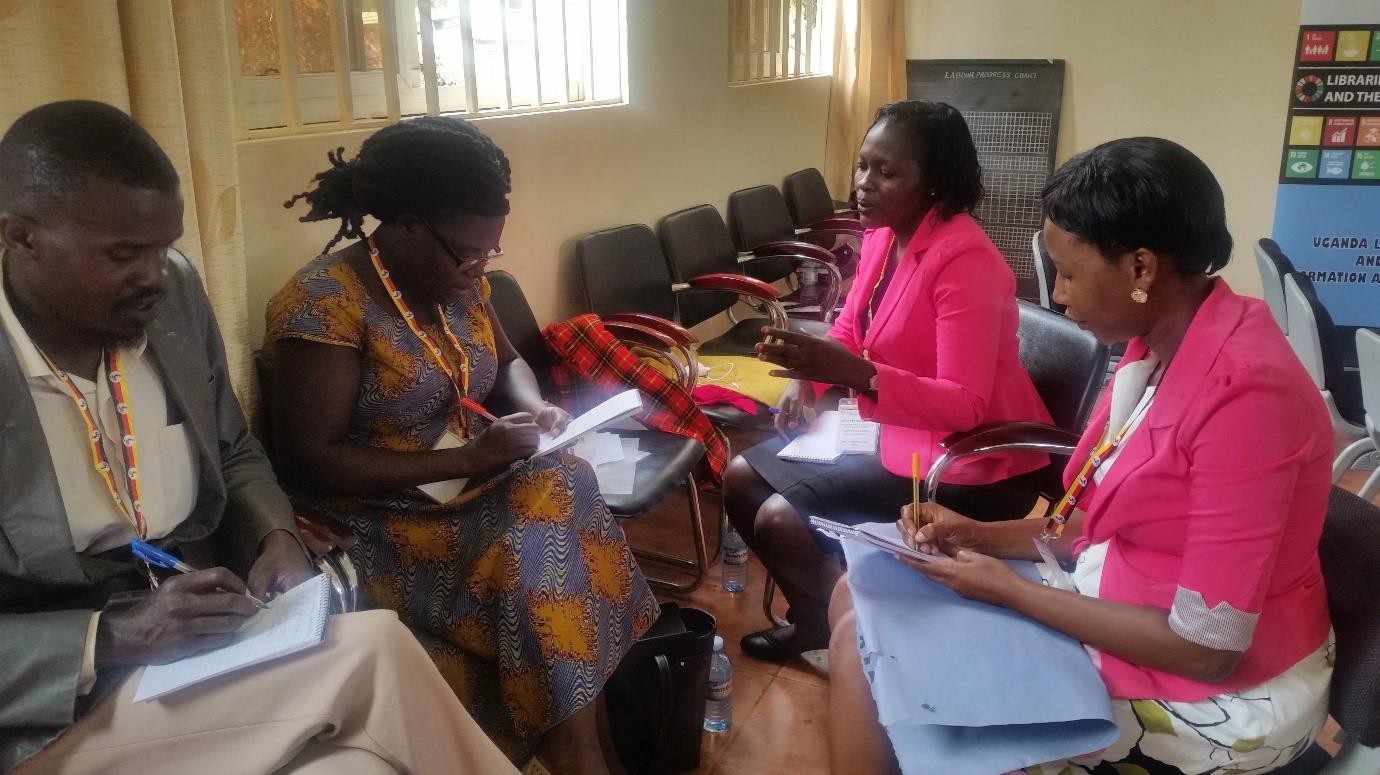
During Group Discussions
The Northern and West Nile Region IAP workshop attracted thirty two (32) Participants who came from: Gulu Regional Referral hospital, Lira University, Lutino Adunu Nwoya community library, Gulu university library, Cavendish university Gulu, Arua public library, Nebbi Municipal Council, Paidha public , one public library, NTC Unyama, Gulu SOCO, Gulu public library, Nebbi public library, Moroto public library, Arua Public library and Gulu District Local Government. The workshop was closed by Dr. Pasca Apio. Dr. Apio said she was hearing about ULIA and SDGs for the first time.
The IAP guns will now shift to Western Uganda in October 2017.

Well-done IFLA and ULIA for informing the world. 

Thursday, July 20, 2017

Librarians and records managers in Zambia take part in IFLA Global Vision discussions

Group discussion on IFLA Global Vision
[Photo: Justin Chisenga]
Participants at the 2017 Library and Information Association of Zambia (LIAZ) Annual Conference in Siavonga, today took part in the International Federation of Library Associations and Institutions (IFLA) Global Vision discussions.

The participants, mainly librarians and records managers from academic libraries, public libraries, special libraries and archives, worked in groups and discussed  how a united library field can meet the challenges of the future.

The discussions, based on the guidelines provided by IFLA, focused on library values and strengths, challenges facing society, libraries and the profession, and potential solutions as part of the process to develop a global vision for a united library field.

A report of the discussions will be prepared and submitted to IFLA as a contribution from the library community in Zambia.

IFLA’s Global Vision discussions were launched on 4 April 2017 in Athens, Greece, under the theme: “Together We Create the Future”. The library community worldwide is being encouraged to participate in the discussions through self-organized workshops and online voting to be launched in August 2017.

Ms. Velenasi Mwale Munsanje, LIAZ President; Dr. Vitalicy Chifwepa and Dr. Justin Chisenga, co-facilitated the discussions.

Wednesday, January 11, 2017

Call for papers: Access to Information Network – Africa (ATINA) Special Interest Group

IFLA's Access to Information Network – Africa (ATINA) Special Interest Group has issued an invitation for papers to be presented at its Open Session at the IFLA World Library and Information Congress,  19–25 August 2017, WrocÅ‚aw, Poland.

The theme of the Group's Open Session will be "Knowledge Systems for Sustainable Development Goals".

For details, visit Access to Information Network – Africa (ATINA) Special Interest Group.

Tuesday, October 6, 2015

50 full fellowships available for IFLA 2016 Congress in Columbus, Ohio


The IFLA 2016 National Committee, through generous donations from the North American library community, will offer up to 50 full fellowships to librarians from outside North America (U.S. and Canada) to attend the IFLA 2016 Congress in Columbus, Ohio.
Visit IFLA 2016 website for detailed information, including eligibility and applications forms for the fellowships.

Monday, August 18, 2014

Lyon Declaration on Access to Information and Development

Please, access, read and sign the Lyon Declaration on Access to Information and Development. The Declaration is also available in PDF in English, French, Arabic and Spanish.

Here is the list of stakeholders that have already signed the Declaration.

The Declaration was drafted by IFLA and a number of strategic partners in the library and development communities between January and May 2014.

Monday, May 19, 2014

IFLA Trends Report: Letter to Chairs/Presidents of Library Associations

Chairs/ Presidents of Library Associations,

The IFLA Trend Report was launched in Helsinki in 2013. It is a discussion document for engagement and comment by the LIS community. SCECSAL has placed the matter on the agenda for discussion at AGM the July 2014 meeting. A panel of experts will lead discussion. Furthermore the Trend Report is also set for discussion on the recently set up Africa-L listserve.

On behalf of the IFLA Regional office for Africa, I would like to ask you and the LIS community in your country to engage with the IFLA Trend report before heading to SCECSAL in July 2014 in Malawi. I request that you please send me a brief report of the outcomes of your discussions so that we can compile a combined report for SCECSAL.

You may access the report on the link http://trends.ifla.org/ or download a PDF copy.
  • TREND 1 New Technologies will both expand and limit who has access to information.
  • TREND 2 Online Education will democratise and disrupt global learning.
  • TREND 3 The boundaries of privacy and data protection will be redefined..
  • TREND 4 Hyper-connected societies will listen to and empower new voices and groups.
  • TREND 5 The global information environment will be transformed by new technologies.
It is envisaged that at the end of the session Africa’s contribution to the Trend Report will be shared with the rest of the LIS global community on IFLA listserve and the newly formed Africa – L list http://infoserv.inist.fr/wwsympa.fcgi/info/africa-l

We look forward to hearing from you and welcome your responses by end June2014. Follow up reminders will be continuously be sent to you before the deadline. Kindly submit your country report to me, copy mbambtb@unisa.ac.za and Justin.Chisenga@fao.org

Regards
Lindy Nhlapo
IFLA Regional Manager for Africa
IFLA Regional Office for Africa

Wednesday, April 9, 2014

Pre-SCECSAL event: BSLA workshop, Lilongwe, Malawi, 26 – 27 July 2014

An IFLA Building Strong Library Associations (BSLA) programme preconference to SCECSAL XXI under the auspices of Malawi Library Association, will be hosted by IFLA in partnership with IFLA Regional Office for Africa on 26 – 27 July 2014 at Sunbird Capital Hotel, Lilongwe, Malawi.  IFLA invites library associations attending SCECSAL to apply to participate in the workshop.

IFLA's successful Building Strong Library Associations (BSLA) programme is being through a series of convenings and projects at the regional level in Africa, Asia and Oceania, and Latin America and the Caribbean from 2014. This workshop is an outcome of the Africa Regional convening held in Kumasi, Ghana, in February 2014.

The workshop will include training from the BSLA programme, group work, discussions, and practical activities to take back to national associations to implement at the national or regional level. During the workshop, associations will identify their own needs for further activities and development and form action plans for implementation. The workshop language will be English.

Expected outcomes
To build a strong library sector that benefits society, associations need a strong foundation in representation, governance, organisational development and strategy. The long-term goal of the programme is to build the foundation for library associations to assist their work in representing the interests of library users, telling the story of libraries and gaining policymaker support and partnership.

The workshop will:

  • Reinforce inter-country networks and expertise to support development in the regions;
  • Increase understanding and adoption of IFLA policies and manifestos to support high quality library and information services.

Register to attend the workshop

Registration is open until 30 April 2014. Attendance at the workshop is at participants’ own expense. Associations that have not participated in BSLA workshops previously are particularly encouraged to attend.

Workshop participants should have:

  • Demonstrated, current active leadership within their national or regional association;
  • A depth of understanding of issues that have a current or expected impact on the library and information services sector on a national and regional level;
  • The ability to use their knowledge and experience to develop the capacity of their Association after the convening.

To register to attend the workshop, contact:

Lindy Nhlapo
IFLA Regional Manager for Africa
IFLA Regional Office for Africa
Tel: +2712 429 6374
        +2711 471 2826
Fax: +2712 429 6130
Mobile: +2772  7145 125
lnhlapo@unisa.ac.za
iflaafrica@unisa.ac.za  

Please include the following details to complete your registration:

  1. National or Regional Association name
  2. Names of the representatives that will attend the workshop, and their position in the Association
  3. Library association profile: does it provide services and run activities for members, have a strong governance structure, a clear direction and strategic plan? Please outline the objectives for your association’s current strategic plan, and an overview of progress towards these goals.
  4. Needs assessment: How will your participation in the workshop  complement any existing development projects that the association is undertaking? What are some of the Library Association's strengths? What are some of the challenges facing the Association?

Monday, December 5, 2011

Call for Papers, Africa Section Open Forum, WLIC, Helsinki, Finland, 2012

The IFLA annual congress will take place in Helsinki, Finland from 11th -17th August, 2012. The Congress offers an opportunity to present library research outcomes and innovations in a multi-disciplinary international forum. In line with the theme of the 78th IFLA WLIC, Africa Section chose the theme: 'Africa Libraries now on open access agenda'. IFLA Africa Section invites Librarians, Information Scientists and other stakeholders to submit proposals (abstracts) for papers at the Africa Section Open Forum session in Helsinki, Finland.

Theme:

"Africa libraries now on open access agenda

 Sub-Themes:

  • Open Access for all in Africa libraries
  • Social networking in Africa libraries
  • Information literacy in Africa libraries on open access agenda
  • Indigenous knowledge for all in Africa libraries
  • Policy issues in open access agenda
  • Continuing Professional Development (CPD) for Africa libraries open access agenda
  • Integration of open access agenda and libraries in Africa: the role of librarians
Submission Guidelines:

The proposal must be the original work of the author(s) and should be written in either English or French. Each abstract must contain:

  •  Title of proposed presentation
  • Outline of the proposed presentation (no more than 350 words)
  • Name(s) of presenter(s)
  • Position or title of presenter(s)
  • Presenter(s) employer or affiliated institution
  • E-mail address, Telephone/fax numbers
  • Short biographical statement of the presenter/s, with digital photograph
Please send proposals by January 14, 2012 by email to:

Rosemary Gitachu
Secretary, IFLA Africa Section,
e-mail: gitachur@yahoo.com

Important Deadlines:

January 14, 2012: Deadline for submission of abstract
February 18, 2012: Notification of acceptance/rejection of paper
May 16, 2012: Deadline for submission of full paper

All proposals will be evaluated by a refereeing team of the Standing Committee of the IFLA Africa Section

Travels and Costs:

Please note that all fees, including registration for the conference, travel, accommodation etc. are the responsibility of the authors of the accepted papers. Presenters are advised to approach their parent organizations for sponsorship.

For information on the IFLA Africa Section, please see
http://www.ifla.org/en/africa