Showing posts with label UNESCO. Show all posts

Thursday, August 10, 2017

ULIA holds second IAP workshop in Northern Uganda: Excitement hits Librarians in the Region

Group photo of some of the Participants
The Uganda Library and Information Association has taken IFLA’s International Advocacy Programmee (IAP) by storm. In less than a month, the professional library body in Uganda has twice made media captions through her IAP workshops. On the 24th to 26th July 2017, ULIA held its inaugural IFLA-IAP workshop at the Uganda Christian University, Mable, and Eastern Uganda. On the 7th to 9th August, 2017, ULIA shifted her IAP sensitization guns to Gulu, far north of the country.  

The workshop was officially opened by Hon. Ojara Mapenduzi- Gulu District LC 5 Chairperson. Honorable Mapenduzi was very pleased to learn that the library fraternity was ready to support the realization of the SDGs and the UN 2030 Agenda.  

He said: “The current global development framework focuses on inclusive philosophy whereby, no one, poor or rich, should be left behind. All the SDGs will require the use of information as key to the UN 2030 Agenda and the SDGs. I am happy Uganda Library and Information Association (ULIA) is making the case for why it is important for all libraries to be central to the UN Agenda and Development. Libraries should empower citizens with choice and control over the decisions that impact their lives, their communities and their nation”. 

The Honorable further promised to work with the librarians in the Northern Uganda to implement his manifesto. He was now aware that libraries had a role to play in the attainment of the UN 2030 Agenda and the SDGs. He was also now aware that the reading culture of his people was still very poor hence the need for an active public library and a vibrant ULIA to manage this challenge.

The local politician was happy to see, the son of the soil – Prof. Constant Okello-Obura, Principal, College of Computing & Information Sciences (CoCIS) and immediate past President of ULIA, talking about development strategies of Gulu district and the role libraries could play in the UN 2030 Agenda.

Dr. Raphael Aregu- University Librarian, Gulu University and Mr. David Tibemenya, Principal Administrator, Gulu Regional Referral Hospital jointly made the welcome remarks. Dr. Sarah Kaddu, the current President of ULIA gave the overview on the IAP workshop.
Principal, Gulu Regional Referral hospital 
addressing participants


Dr. Kaddu, who is also an IAP Trainer, imparted knowledge and skills to the participants on how they could develop library programmes and align them to the National Development Agenda, Vision 2040, the Cape Town Declaration 2015 (Agenda 2063), and the Lyon Declaration 2013. Kaddu put particular emphasis on Goal 16:10 which directly speaks to the libraries and access to information. She further emphasised working with decision and policy makers towards developing library programmes that are aligned with the current development agendas within Uganda.

Currently, Northern Uganda has got a total of 30 districts, making it one of the biggest provinces in Uganda. The region is well known for the infamous civil war led by Joseph Kony. The region suffered from civil unrest since the early 1980s and this lasted for over two decades. 

Hundreds of people were killed in the rebellion against the Ugandan government, and an estimated 1.4 million people were left homeless. The war not only displaced people but also utterly destroyed northern Uganda’s social services sector including agriculture, education, transport, health and the economic base.  Programs such IAP are seen as timely and God sent for the natives. They are geared towards restoring hope and parity in the region.

Speaking after the Workshop, Mr. Steven Okurut commented: “This is God sent. As a result of this workshop, I now know the role of my public library; I can now take the duty I had declined, to brief my Area MP and my Council about the role of Moroto public library. Certainly I shall request for his full support in mobilising resources for its development and my advocacy work begins next week.’

Ms. Shilla Adyero, a Community Librarian was all praises for the workshop because many of the participants heard of ULIA for the first time. Ms Adyero and her colleagues vowed to support the ULIA programs to advocate for the library programmes and the role of her community library in disseminating information for development thereby supporting the UNESCO Agenda, 2030. 

At the end of the workshop, participants had developed the draft Advocacy programmes that they would further share with the decision and policy makers. They were particularly very grateful that ULIA was rolling out the Advocacy workshop to ALL regions of Uganda and East Africa. To them, advocacy is not one of the courses the LIS schools have considered in their curricular yet very important. They promised to initiate change in their libraries and also partner with decision makers, community leaders, policy makers and all the people who may cause change in the library services sector.
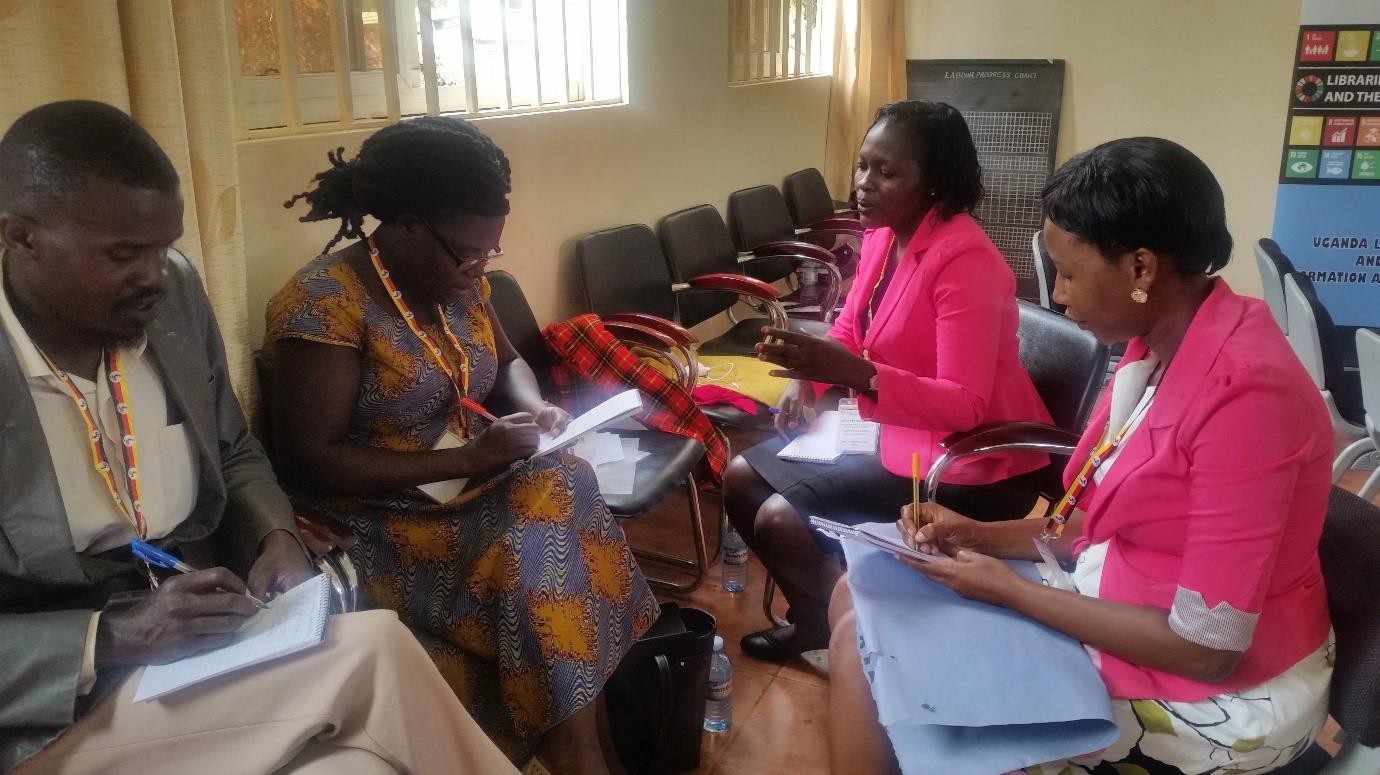
During Group Discussions
The Northern and West Nile Region IAP workshop attracted thirty two (32) Participants who came from: Gulu Regional Referral hospital, Lira University, Lutino Adunu Nwoya community library, Gulu university library, Cavendish university Gulu, Arua public library, Nebbi Municipal Council, Paidha public , one public library, NTC Unyama, Gulu SOCO, Gulu public library, Nebbi public library, Moroto public library, Arua Public library and Gulu District Local Government. The workshop was closed by Dr. Pasca Apio. Dr. Apio said she was hearing about ULIA and SDGs for the first time.
The IAP guns will now shift to Western Uganda in October 2017.

Well-done IFLA and ULIA for informing the world. 

Friday, February 3, 2017

SCECSAL 2018: First announcement and call for papers

The Twenty-Third Standing Conference of Eastern, Central and Southern African Library and Information Associations (SCECSAL XXIII), Entebbe, Uganda, 23rd – 28th April 2018

 Call for Papers

The SCECSAL XXIII Organizing Committee has the pleasure of inviting Library and Information Professionals to the twenty third Standing Conference of Eastern, Central and Southern Africa Library and Information Associations (SCECSAL XXIII) to be hosted by the Uganda Library and Information Association (ULIA), in Entebbe, Uganda.   
SCECSAL is a bi-ennial conference founded in Nairobi in 1978, after the dissolution of the East African Library Association. It is the biggest conference for Library and Information Science (LIS) professionals on the continent and its purpose is to provide a platform for learning and sharing experiences on LIS developments in the region. Currently the conference has Library and Information Association members from the following countries:  Angola, Botswana, Burundi, Congo Republic, Democratic Republic of Congo, Djibouti, Eritrea, Ethiopia, Kenya, Lesotho, Malawi, Madagascar, Mauritius, Mozambique, Namibia, Rwanda, Seychelles, Somalia, South Africa, South Sudan, Sudan, Swaziland, Tanzania, Uganda, Zambia and Zimbabwe. 

SCECSAL XXIII in Kampala will build on the fine tradition of this conference being the leading forum in Africa for headlining the role of library and information institutions in cultural and social development. Best practices and cutting edge innovations in fields as diverse as documenting and preserving national literary heritage and arte facts; driving the research, scientific and scholarship agenda; promoting mass literacy and; open government, human rights, democracy and accountability will be shared and showcased in the plenary presentations, workshops, posters and a conference exhibition.

This conference is coming at a time when countries in the region have made marked advances towards the attainment of Education for All (EFA) goals as noted by UNESCO. Equally to be noted, is that the same countries have registered tremendous progress in other development areas including: agriculture, health, governance, human rights, culture etc. It is therefore a timely opportunity for the library and information sector to develop a regional agenda for boosting their contribution to their countries’ development programmes especially in the context of the UN agenda 2030 and the Sustainable Development Goals (SDGs). 

Investments in Information and Communication Technologies (ICTs) especially in respect to Internet sub-marine cables and national backbones have grown, with attendant funds for ‘last mile coverage. Accordingly, the library and information sector in the region has been at the forefront of adopting measures to enhance access to information such as building institutional repositories, developing electronic collections including eBooks, e-journals; and the use of e-readers in public libraries to promote reading. There are still many challenges that have to be overcome for library user communities to have a full experience of hybrid library and information services such as lack of local content, varied pricing models, subscription licensing and privacy concerns.
It is in view of the above issues that members of SCECSAL will in 2018 convene in Kampala to draw up joint strategies for advocating and advancing library and information development in the region to facilitate LIS to play their cultural, educational roles and support innovations.

Objectives of the Conference

1. To devise strategies that will enable LIS inclusion in national development plans;
2. To provide a platform for learning new initiatives and innovations in the field of LIS from within the region;
3. To promote partnerships, networking and professional exchanges within and outside the SCECSAL region
Participants
Participants will include, among others: Librarians, Archivists, Records Officers, Information Scientists, Publishers, Authors, Book Distributors, Academics, Researchers, ICT Innovators, Literacy Experts, Policy makers and other persons with an interest in the Library and Information Sector in the SCECSAL region. As the conference has grown in importance over the years, participants are expected to come from the SCECSAL member countries as well as West and North Africa, Europe and United States.
ULIA welcomes proposals for papers to be presented at the conference. The papers are expected to include both the theoretical and practical elements of Records, Library and Information Science. 

Theme: Positioning Library and Information services to achieve Sustainable development: Innovations and Partnerships.

Sub Themes:
1. Inclusive library and information services for national development
2. Universal literacy through library and information services
3. Broadening LIS partnerships to achieve SDGs
4. Innovations in LIS Education
5. Innovations in the delivery of Library and information services
6. Trends in Gender and information services
7. Library and Information Services advancing open governance
8. Agricultural information services and food security
9. Bettering health through Library and information services
10. Open data, Open science and Intellectual property
11. Data science and LIS institutions
12. Cloud Computing and Information management
13. Indigenous knowledge and preservation of cultural heritage
14. Effective records management to fight corruption
15. Promoting Information Ethics for sustainable development

Requirements for submission of Abstracts for papers:

Abstracts of not more than 300 words, must address the theme and sub-themes, and should have the following details:
i) Title of the abstract;
ii) Name(s) of the author(s) with official titles or professional role;
iii) Author’s affiliated institution;
iv) E-mail contact of the corresponding author, and;
v) A maximum of four keywords.

The abstracts must be submitted to email: scecsal2018@ulia.or.ug

Important Dates:
Submission of Abstracts :      30th April 2017
Notification of acceptance:   June 2017
Submission of full paper:      September 2017
Review of submitted paper: October 2017
Submission of camera ready paper:  December 2017

For more information about the conference please visit the links below: