Showing posts with label Kenya. Show all posts

Friday, May 3, 2024

Reflecting on my first SCECSAL Conference: Insights from Bosco Buruga

By Bosco Buruga, Librarian, Muni University, Uganda

It is exactly one week since the XXVI SCECSAL Conference ended in Mombasa. A truly inspiring experience of some sorts for the delegates both first-timers and regulars. The conference was a vibrant gathering of brilliant minds, each sharing their unique research findings and perspectives. We asked some delegates specifically those attending the region professional showpiece for the first time to share their insights about the conference and this is what they had to say. 

The conference was a transformative experience that allowed me to deeply appreciate the LIS landscape.

My name is Bosco Buruga, a librarian at Muni University, and an executive committee member of the Uganda Library and Information Association (ULIA) representing Northern Uganda. I would like to share some of my experiences at the SCECSAL XXVI 2024 Conference and Assembly held in Mombasa, Kenya from 22nd to 26th April, 2024. This conference was not just an event, but a transformative experience that allowed me to deeply appreciate the library and information science landscape in Eastern, Central, and Southern Africa.

Mr.Bosco Buruga presenting his paper during SCECSAL XXVI

When I learned that the 2024 SCECSAL Conference was going to be hosted by the Kenya Library Association, I saw it as a golden opportunity for me to attend the first SCECSAL Conference in my career. I immediately sprang into action, strategizing on how I could participate in this life-enriching conference. 

The first step was setting a goal for myself: to broaden my professional network and gain knowledge from the conference presentations. The second step was responding to the call for abstracts. I, along with two other colleagues, wrote an abstract and submitted it to the local conference organizing committee. I am grateful that our abstract was accepted, and we were able to submit a full paper, marking the beginning of a truly enriching journey. Our paper was Applying SWOT analysis to assess drivers and barriers of using e-resources among selected academic libraries in Uganda.

My dream of attending the SCECSAL XXVI 2024 Conference at PrideInn Paradise Beach Resort, Convention Centre & Spa Mombasa almost died because I failed to get funding from my institution to pay for conference fees, accommodation, and transport. I decided not to disappoint myself by missing the golden opportunity to attend my first SCECSAL Conference. I borrowed money and ventured into an exciting trip of about 1,700 km on the road using a bus from Arua City in northern Uganda to Mombasa, Kenya, for this important professional event of my life. It took me three days to reach Mombasa and another three days to return to Arua after the conference. Some Ugandan colleagues who flew from Mombasa arrived in Kampala before I started my journey from Mombasa to Nairobi city.

The sacrifice that I made to attend SCECSAL 2024 enabled me to achieve the following:

1. I had the rare opportunity to represent the president of the Uganda Library and Information Association (ULIA), as a SCECSAL delegate. This enabled me to attend the SCECSAL General Council Meeting. You cannot imagine my joy in representing ULIA and attending a meeting of Presidents of Library Associations in Eastern, Central and Southern Africa. The sacrifice I made was worth it because I networked and knew the leaders of the African Library Associations in person. I am happy I actively represented my country well because I made valuable submissions in the meeting.

2. The conference presentations were rich in content and aroused my desire to do more research and build collaborations and networks. I was moved by the president of the Library and Information Association of Zambia (LIAZ) 's presentation on supporting SDGs initiatives by establishing a children's information centre in a public hospital. I am reflecting on her presentation and developing a concept that will be used to source supporters and possible donors for establishing such an information centre in our regional referral hospital.

3. I was able to present my conference paper and received very good feedback from the conference participants. The positive reception has motivated me to respond in the future to other calls for abstract submission from SCECSAL and/or any other relevant professional conferences.

4. I met esteemed personalities in the profession, such as Prof. Clara Chu, Prof. Maria G. N. Musoke, Dr. Justin Chisenga, Dr. Kay Raseroka, Madam Getrude Kayanga Mulindwa, and Ms Jacinta Were. I was blessed to have tapped knowledge from these celebrated personalities in SCECSAL. May God give them more years to mentor us in the profession. 

5. I attended the Cultural Evening, which was characterised by a dancing competition from diverse African cultures and an awards ceremony. Africa is blessed with beautiful dances, but the time for the cultural evening was not enough. I was blessed with another opportunity to receive an award on behalf of Phenny Birungi (SCECSAL Presidents Award) and another for ULIA (SCECSAL Hosts Award).

Ugandan delegates performing during the cultural evening

6. Throughout the conference, I had the opportunity to attend various sessions from exhibitors, ranging from library systems or technologies to library information resources. All the sessions provided unique perspectives and valuable takeaways, making the conference enjoyable and less boring.

In a nutshell, the SCECSAL Conference 2024 was a success because I enjoyed all the aspects of the conference, ranging from paper presentations, workshop sessions, and Country SDGs reports to SCECSAL Country reports. A crucial take-home assignment is that, as a Ugandan librarian, I need to get involved in documenting and sharing my library's contribution to supporting the implementation of the SDGs. I will now be an ambassador of SDGs in my Library Association. I have already recommended the SCECSAL conference to my young colleagues in the profession because it offers them an opportunity to expand their professional network and fresh insights and perspectives that will enrich their work moving forward.

Mr. Buruga receiving an award on behalf of Phenny Birungi

I have started preparing for the SCECSAL conference of 2026, which the Library and Information Association of Zambia will host in the city of Livingstone. This is my time to visit the home of the Victoria Falls. God willing, I will have to be physically in Zambia to consolidate my established professional networks, get new ones, and participate in knowledge exchange in the SCECSAL region by presenting conference papers and listening to other presenters. God bless SCECSAL and its leadership.

Thursday, April 25, 2024

We need to interest ourselves with the new technologies for linked data

The web has evolved from the global documents space of both documents and data. This  evolution is underpinned by a set of best practices for publishing and connecting structured data on the web, known as Linked Data. According to Winny Akullo Nekesa, Manager Libraries at NSSF Uganda, librarians need to familiarize themselves with the latest technological advancements in order to effectively organize data and integrate it  with other systems so that we can easily share with our users. Although some librarians still feel challenged in understanding the concept of Linked data, many of them in Uganda  

Ms Winny Nekesa, Manager Library, NSSF Uganda

In separate presentation, Ms Esther N. Tobias, a chief librarian from Namibia government ministry noted that some libraries in Namibia exclude marginalized users due to the fact that libraries fear that the majority of their users will feel uncomfortable or unsafe if the marginalized groups are allowed to enter the library.  

These were highlighted as SCECSAL 2024 entered its fourth day at PrideInn Paradise Hotel, Mombasa Kenya.

Thursday, October 24, 2019

EASLIS, CoCIS host Workshop on Digitalising LIS Curriculum.

The East African School of Library and Information Sciences (EASLIS), College of Computing & Information Sciences (CoCIS), Makerere University in partnership with King’s College London (KCL) recently hosted a workshop on digitalizing the curriculum from 7th to 9th:, October 2019. The workshop theme was: “Towards an Education Programme for Digital Information Science in East Africa”, attracted a total of 37 participants from Uganda, Kenya, Rwanda and Nigeria, many of whom were academics and practitioners. In her introductory remarks, the workshop coordinator, Dr. Sarah Kaddu highlighted the aims of the workshop as to:  ensure that participants gain a plan of digitalised curriculum in 20th century, identify the key components of the digital curriculum, come up with the requirements of the digitalised curriculum, and, also draft an outlie curriculum an information science programme as they saw it fit.

In his welcome remarks, the Dean of EASLIS Professor Constant Okello -Obura noted that there was need for information professionals to reflect on the current trends, discover what is new in the world, and understand the skills and competencies required for the changing times. He also emphasized the need for the Fourth Industrial Revolution (4th IR) skills and competencies which appreciates the new technologies used currently. Professor Obura also highlighted the need to develop smart ways, and to discover methods to make information responsive to the demand for the situation out there in the world.

In attendance, was the Principal College of Computing and Information Sciences (COCIS) Prof. Tonny Oyana who also represented the Deputy Vice Chancellor for Academics. In his remarks, Professor Oyana noted that digitalising the curriculum is at the forefront of the College of Computing and Information Sciences. He specified that a lot needs to be done in terms of considering the structured, semi structured and unstructured data.  In terms of disseminating information, Prof. Oyana pointed out that there are different types of consumers for example, children, gender component, old age, and the need to cater for all this audience.

Participants of the Workshop
On issues concerning the level of detail that is required (content), Oyana noted that there are behavioral components determined by the different audiences, such as issues of costs and as well as standards. He advised all the information professionals to be aware of all the laws, polices and standards within the country and beyond. He gave an example of the recent Uganda Data Protection Act that was passed earlier this year. He reminded all the stakeholders that digitalizing the curriculum requires hardware, software and human resources. 

Some of the topics covered during the three day workshop included: The Job Market for Digital Information Experts, the (Galleries, Libraries, Archives and Museums- GLAM),  Resources and Strategies for successful implementation of digital information science education curriculum, practice and research in East Africa, research data management, Computational Archival Science – Computational Methods and Digital Archives and Information Ethics in Digital Archiving among other. Among the facilitators were Mark Hedges and David Jordan from King’s College London. 

The workshop was a huge success and of immense benefit to all the participants. Participants noted that the job market for digital archivists exists; but currently, they are out sourced. It was also noted that in most cases, the records managers are not part of the team that designs the systems and yet they are expected to run these systems. It was agreed that there is a crucial need for LIS professionals to work together with IT professionals. It was evident that there is a huge importance to look at IT as a tool and not as replacing Librarians and or Information Professionals since the role of the librarians/Information professionals is to connect users to the information they need. 
Workshop participants in a group discussion
It was also noted that presently, there is no curriculum that prepares learners to be digital experts; it only stops at the elementary. Therefore Library and Information Science schools should introduce options in the curriculum so that students can have more time and have hands-on with the digital aspects. On the role of the students, much emphasis was put on changing the mindset of students in order to explore the opportunities for becoming digital experts. Furthermore, some participants felt the need to conduct tracer studies for the digital aspects and the employers’ needs. 

In his closing remarks, Prof Constant Okello Obura noted that LIS schools needed the advice of employers, urging the employers who were present to keep in touch with LIS schools so that they can get the right graduates. He also advised the Uganda Library and Information Association to take up the initiative and support the implementation of this digitalized curriculum.

Friday, August 1, 2014

SCECSAL 2014 cultural evening

South Africa

Zambia

Uganda

Kenya

Dancing to Kukere by by Nigerian recording artist Iyanya

Namibia

Botswana
Traditional dancers from Malawi

Tuesday, June 12, 2012

SCECSAL 2012: Post Conference Views

Uganda Library and Information Association members
Winners of SCECSAL 2012 Culltural Evening Performance
I commend Kenya Library Association (KLA) for a successful SCECSAL 2012 conference. The attendance at the conference was more than I had expected. About 330 delegates, including the largest airborne delegation of about 40 participants from Zambia, took part in the conference. About 78 papers were presented, and the quality of most presentations was very high. The conference venue (Laico Regency Hotel) was ideal, and of course, the food during lunch breaks was great. The conference registration fee (US$300), although some would say that it was relatively high, I think was ok considering the costs involved in organizing such conferences. Performances during the Cultural Evening, on 6 June, were outstanding.  Shame on Malawi Library Association (MALA) for refusing to perform. I hope MALA learned a lesson from the lone rangers from Nigeria, Norway and United Kingdom who put up excellent performances. Congratulations to Uganda Library and Information Association for winning the Cultural Evening trophy. I never knew that library and information professionals could double as traditional dancers until I watched the act from Uganda. They were original, well organized, and deserved to win. I suspected that Kenya Library Association tried to rig the competition. I could hardly recognize any of the dancers in the Kenyan group. Where were all the well-known library and information professional dancers from Kenya? Jacinta Were? Rosemary Gitachu? Joseph Kiplang’at? Constantine Nyamboga? Tirong arap Tanui? Peter Weche, although officially not part of the dancing group, did his best to support the dancing group by illegally dancing on the floor (and not on the designated dancing area). It was too late. Mmmmmmmmm! I enjoyed the evening. The music by Kayamba Africa was great.
The challenge is now for Malawi Library Association (MALA), designated host for SCECSAL 2014, to beat SCECSAL 2012. In my view, the areas requiring improvement, which MALA should look at, include the following:
  •  Registration process: the registration process at SCECSAL 2012 could have been better. I am sure that some individuals took advantage of the seemingly uncoordinated process and participated in the conference without registering and paying the registration fee. It is advisable to commence onsite registration at least a day before the conference to carter for the early arrivals, especially participants coming from outside the country.
  • Access to conference venue/meeting rooms: only registered participants with valid participant’s badges MUST be allowed to enter the meeting rooms. Free access to the conference rooms at SCECSAL 2012 contributed to the security breaches and loss of valuable items experienced during the conference.
  • Conference papers: some paper presenters complained that their papers were not included in the publication containing the conference papers. I know how difficult it might have been for KLA to have all the papers submitted in time for the publication. Maybe in future the organizers should inform potential paper presenters/authors to submit papers by a certain date, if they are to be included in the publication. Inclusion in the publication of paper submitted after that date should be at the discretion of the SCECSAL host Association. Host Associations should also ensure that basic editing and layout of the papers to ensure uniformity and consistence is done. This is visibly missing from the SCECSAL 2012 publication.
  • Author Awards: why is it that only Namibia (2000) and South Africa (2002) managed to organize SCECSAL Author Awards? The Author Awards page on the SCECSAL web site outlines clearly the guidelines for awards.  Shame on Uganda Library and Information Association (2004), Tanzania Library Association (2006), Zambia Library Association (2008), Botswana Library Association (2010) and Kenya Library Association (2012) for failing to organize the Author Awards competition!. Shame will also be on MALA if they fail to do so in 2014. As my Nigerian brothers and sisters would say: Chineke! God forbid.
  • Minutes of the General Assembly: follow-up on the deliberations of the SCECSAL General Assembly is rather poor due to late distribution of the minutes of the meeting. Why should SCECSAL member Library Associations accept to distribute the minutes of the meeting two years after the meeting? Let  Article 5 (5.6) of the SCECSAL constitution guide the host associations on this matter.
Zambia Library Association members
Runners-up SCECSAL 2012 Culltural Evening Performance
For my last word, let me say that I felt sorry for my sister (Nomsa Mkwanazi) from Swaziland Library Association (SWALA) when she was presenting SWALA’s bid to host SCECSAL 2014. SWALA lost the bid to KLA in 2012 and I am assuming that they were on standby to host 2012 SCECSAL. If this was the case, then all that was required from SWALA was to follow the procedure outlined in Article 6 (6.6) of the SCECSAL Constitution, and SCECSAL 2014 would have been theirs to host. No bids would have been required. SWALA, pleaase, give it a thought for SCECSAL 2016.

Saturday, June 9, 2012

Sights from the Closing Day of SCECSAL 2012

Dr. L. Dube from UNISA
Participant from Nigeria making a contribution
Participants during the closing session

Prof. Constantine Nyamboga (in suit) taking over Chairmanship of SCECSAL

Thursday, June 7, 2012

Sights from 7 June Sessions

Khosie Ndlangamandla making a presentation during the session on Education and Training
Session on Knowledge Management
Participant asking a question during the session on Education and Training

Tuesday, June 5, 2012

Sights from SCECSAL 2012, Nairobi, Kenya

SCECSAL 2012 Opening Session
SCECSAL Participants
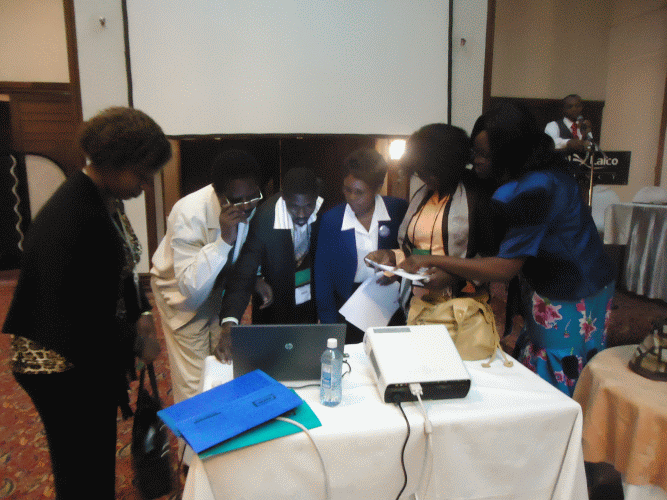
Presenters loading their PPT files
Mrs Jacinta Were asking a question
Book Exhibition
Thomas Junck Representative of 3M presenting on 3M products and services
Peter Weche from Kenya making a contribution
Bhule Bambo-Thata from University of South Africa