Showing posts with label SDGs. Show all posts

Friday, May 3, 2024

Reflecting on my first SCECSAL Conference: Insights from Bosco Buruga

By Bosco Buruga, Librarian, Muni University, Uganda

It is exactly one week since the XXVI SCECSAL Conference ended in Mombasa. A truly inspiring experience of some sorts for the delegates both first-timers and regulars. The conference was a vibrant gathering of brilliant minds, each sharing their unique research findings and perspectives. We asked some delegates specifically those attending the region professional showpiece for the first time to share their insights about the conference and this is what they had to say. 

The conference was a transformative experience that allowed me to deeply appreciate the LIS landscape.

My name is Bosco Buruga, a librarian at Muni University, and an executive committee member of the Uganda Library and Information Association (ULIA) representing Northern Uganda. I would like to share some of my experiences at the SCECSAL XXVI 2024 Conference and Assembly held in Mombasa, Kenya from 22nd to 26th April, 2024. This conference was not just an event, but a transformative experience that allowed me to deeply appreciate the library and information science landscape in Eastern, Central, and Southern Africa.

Mr.Bosco Buruga presenting his paper during SCECSAL XXVI

When I learned that the 2024 SCECSAL Conference was going to be hosted by the Kenya Library Association, I saw it as a golden opportunity for me to attend the first SCECSAL Conference in my career. I immediately sprang into action, strategizing on how I could participate in this life-enriching conference. 

The first step was setting a goal for myself: to broaden my professional network and gain knowledge from the conference presentations. The second step was responding to the call for abstracts. I, along with two other colleagues, wrote an abstract and submitted it to the local conference organizing committee. I am grateful that our abstract was accepted, and we were able to submit a full paper, marking the beginning of a truly enriching journey. Our paper was Applying SWOT analysis to assess drivers and barriers of using e-resources among selected academic libraries in Uganda.

My dream of attending the SCECSAL XXVI 2024 Conference at PrideInn Paradise Beach Resort, Convention Centre & Spa Mombasa almost died because I failed to get funding from my institution to pay for conference fees, accommodation, and transport. I decided not to disappoint myself by missing the golden opportunity to attend my first SCECSAL Conference. I borrowed money and ventured into an exciting trip of about 1,700 km on the road using a bus from Arua City in northern Uganda to Mombasa, Kenya, for this important professional event of my life. It took me three days to reach Mombasa and another three days to return to Arua after the conference. Some Ugandan colleagues who flew from Mombasa arrived in Kampala before I started my journey from Mombasa to Nairobi city.

The sacrifice that I made to attend SCECSAL 2024 enabled me to achieve the following:

1. I had the rare opportunity to represent the president of the Uganda Library and Information Association (ULIA), as a SCECSAL delegate. This enabled me to attend the SCECSAL General Council Meeting. You cannot imagine my joy in representing ULIA and attending a meeting of Presidents of Library Associations in Eastern, Central and Southern Africa. The sacrifice I made was worth it because I networked and knew the leaders of the African Library Associations in person. I am happy I actively represented my country well because I made valuable submissions in the meeting.

2. The conference presentations were rich in content and aroused my desire to do more research and build collaborations and networks. I was moved by the president of the Library and Information Association of Zambia (LIAZ) 's presentation on supporting SDGs initiatives by establishing a children's information centre in a public hospital. I am reflecting on her presentation and developing a concept that will be used to source supporters and possible donors for establishing such an information centre in our regional referral hospital.

3. I was able to present my conference paper and received very good feedback from the conference participants. The positive reception has motivated me to respond in the future to other calls for abstract submission from SCECSAL and/or any other relevant professional conferences.

4. I met esteemed personalities in the profession, such as Prof. Clara Chu, Prof. Maria G. N. Musoke, Dr. Justin Chisenga, Dr. Kay Raseroka, Madam Getrude Kayanga Mulindwa, and Ms Jacinta Were. I was blessed to have tapped knowledge from these celebrated personalities in SCECSAL. May God give them more years to mentor us in the profession. 

5. I attended the Cultural Evening, which was characterised by a dancing competition from diverse African cultures and an awards ceremony. Africa is blessed with beautiful dances, but the time for the cultural evening was not enough. I was blessed with another opportunity to receive an award on behalf of Phenny Birungi (SCECSAL Presidents Award) and another for ULIA (SCECSAL Hosts Award).

Ugandan delegates performing during the cultural evening

6. Throughout the conference, I had the opportunity to attend various sessions from exhibitors, ranging from library systems or technologies to library information resources. All the sessions provided unique perspectives and valuable takeaways, making the conference enjoyable and less boring.

In a nutshell, the SCECSAL Conference 2024 was a success because I enjoyed all the aspects of the conference, ranging from paper presentations, workshop sessions, and Country SDGs reports to SCECSAL Country reports. A crucial take-home assignment is that, as a Ugandan librarian, I need to get involved in documenting and sharing my library's contribution to supporting the implementation of the SDGs. I will now be an ambassador of SDGs in my Library Association. I have already recommended the SCECSAL conference to my young colleagues in the profession because it offers them an opportunity to expand their professional network and fresh insights and perspectives that will enrich their work moving forward.

Mr. Buruga receiving an award on behalf of Phenny Birungi

I have started preparing for the SCECSAL conference of 2026, which the Library and Information Association of Zambia will host in the city of Livingstone. This is my time to visit the home of the Victoria Falls. God willing, I will have to be physically in Zambia to consolidate my established professional networks, get new ones, and participate in knowledge exchange in the SCECSAL region by presenting conference papers and listening to other presenters. God bless SCECSAL and its leadership.

Thursday, April 25, 2024

Innovative libraries need innovative leaders

Innovative libraries are critical community assets with services that bring information, in all formats, to everyone in the community. According to Professor Prof Clara M. Chu, innovative libraries need innovative leaders. Librarians and library staff must become library leaders, willing to challenge the status quo for the sake of providing valued services to their users.

Professor Clara M. Chu, who is the Director and Mortenson Center Distinguished Professor, Mortenson Center for International Library Programs, University of Illinois Urbana-Champaign affirmed to this during a workshop she conducted for the delegates at SCECSAL 2024, in Mombasa Kenya on the 24th of April 2024.

Prof Chu noted that “Leadership is influencing people to take action. She further noted that in the workplace, leadership is the art of getting work done through other people. Leadership can be widely distributed within an organization – most everyone leads at some time or another, if not all the time. And it’s highly situational: anyone might step forward to lead, given the right circumstances.”

Prof Clara M. Chu

While citing Daniel Golema’s Leadership Styles, the distinguished Professor noted that every leader showcases many, if not all the styles advanced by Daniel Goleman such as Commanding leadership, visionary leadership, affiliative leadership, democratic leadership, pacesetting leadership and coaching leadership. 

She urged all library leaders to solve the right problems by deeply defining the problem while taking the responsibility for the problem & avoid blaming others.  
She further advised delegates to always sufficiently gather information regarding problems, discuss solutions, implement the best solution and reviewing the decision. 

In another workshop conducted by Professor Omwoyo Bosire Onyancha from the College of Human Science, University of South Africa, he discussed the aspect of bibliometrics/ informatrics support services in libraries. Onyancha said bibliometrics support services are critical in empowering academic librarians to navigate the metrics tide in academic libraries in Sub-Saharan Africa. 

While addressing the delegates on the topic “Navigating the Rising Research Metrics Tide: Opportunities for Academic Librarians in the 21st Century”, Prof Onyancha warned that academic librarians in sub-Saharan Africa, just like their counterparts in the rest of the world, are under pressure to provide relevant information services to satisfy varied client needs. Research administrators, grant offices, researchers, students and university managers, among others, are increasingly turning to academic librarians for information to meet their numerous research-related information and metrics needs.

Professor Omwoyo Bosire Onyancha

Sub-Saharan African countries’ emphasis on strengthening science, technology and innovation has exerted further pressure on information professionals and other stakeholders to develop and appropriately apply bibliometrics and altmetrics to inform decision-making and policy-formulation processes. Research output and impact metrics are not only quickly evolving but their volume has been unprecedented.

He advised that as librarians, we need to: create awareness of different metrics-yielding tools and the metrics used to measure research performance among academics;  identify and suggest the most relevant and high-quality journals where authors can publish their papers; provide explanations on why specific journals are not suitable places to publish (for example, predatory and hijacked journals); and provide information on the type of metrics that can be used for specific research-related purposes among other roles. 

Prof Onyancha also noted that the changing nature of the environment demands a commitment to lifelong learning with academic librarians being more self-directed and self-motivated to develop new skills that will enable the fullest use of new technology and resources.

Wednesday, March 6, 2024

SCECSAL and SDGs

Copyright: IFLA
Libraries, library associations and information professionals play a central role in the implementation of the 2030 Agenda for Sustainable Development and the associated Sustainable Development Goals (SDGs). The member associations of the Standing Conference of Eastern, Central and Southern African Librarians (SCECSAL) have recognized this importance and have taken proactive steps to align their activities with both the national and global development agendas.

At the 2014 SCECSAL conference in Lilongwe, Malawi, a resolution was adopted to synchronize their efforts with the post-2015 strategies to contribute to the achievement of the SDGs. Eight years later, in 2022, SCECSAL members decided to link their library and information services activities to the SDGs and make them an integral part of the biennial SCECSAL country reports.

The SCECSAL conferences planned for 2024, 2026, 2028 and 2030 will feature plenary sessions on libraries, information services and SDGs in the SCECSAL region. These sessions will include presentations and panel discussions and will provide a platform for sharing insights and experiences on how libraries and information services are actively contributing to sustainable development efforts in the region.

Through the resolutions adopted at the SCECSAL conferences and the initiatives implemented by member Associations, SCECSAL demonstrates its commitment to harnessing the power of libraries and information services to advance the SDGs and promote positive change in the Eastern, Central and Southern Africa region. Such concerted efforts underscore the critical role that library and information professionals play in shaping a sustainable future for all.

Tuesday, May 8, 2018

SCECSAL members associations resolve to report regularly on their contributions to development agendas

Uganda Minister of State for Gender and Culture, Madame Mutuuzo Peace (middle)
with members of the SCECSAL General Council during
the opening session of SCECSAL 2018 
The SCECSAL General Council, on 27 April, in Entebbe, Uganda, adopted a resolution to force
member associations to report on activities carried out in their respective countries in support of the implementation of the global or Africa-wide or national development agendas on a biennial basis.

Henceforth, all future SCECSAL conferences will include a session at which SCECSAL member national library (information) associations will be required to present reports on their contributions to the development agendas.

In 2014, in Lilongwe, Malawi, the General Assembly had called upon the member associations to align their activities to the national and global development agendas and develop post 2015- strategies, something which very few associations have done.

The Entebbe meeting also:
  • requested member Associations to establish partnerships with LIS schools and agree on modalities for multi-stakeholder processes for all future library and information studies curriculum design or revisions
  • resolved to establish a SCECSAL Committee of Focal Points (CFP) whose main function shall be to manage day to day SCECSAL activities with the support of the SCECSAL Secretariat.
  • called upon member Associations to work with organisations for the people with disabilities and organisations for the visually impaired people and advocate for the ratification and domestication of the Marrakesh Treaty in their respective countries.

A copy of the SCECSAL 2018 resolutions is available on the SCECSAL website.

Sunday, April 29, 2018

SCECSAL 23rd ends as Namibians steal the show on final day

The 23rd SCECSAL Conference came to a close on Friday 27th April, 2018 at the Imperial Resort Beach Hotel, Entebbe.

The five day event that started on 23rd April was the third time the Uganda Library and Information Association (ULIA) was hosting the regional event, having hosted the event in 1990 and 2004.

Speaking at  the closing ceremony, SCECSAL President Dr. John Paul Anbu, conveyed his sincere appreciation to the hosts ULIA and the National Organizing Committee (NOC), the delegates and all sponsors who made the 23rd Conference a success. Dr Anbu was speaking for the last time as SCECSAL President before handing over the office to Dr Sarah Kaddu of Uganda.

The last day started off with three expert panel discussions which were well attended by delegates. More than 200 delegates from fifteen Library associations in Africa and beyond attended the Conference. 
Dr Sarah Kaddu and Dr John Paul Anbu
during the SCECSAL General Assembly
In her closing remarks, ULIA President Dr Sarah Kaddu thanked everyone for making the 23rd SCECSAL conference a great success. She noted that the process of managing the SCECSAL conference  had been long and challenging not mentioning demanding physical, material, financial, spiritual and emotional support.

The conference theme: “Positioning library and information services to achieve sustainable development: innovations and partnerships” was thoroughly addressed through pre-conference  workshops, paper presentations, session discussions, poster sessions and expert panel discussions. Fifteen sub-themes  were cross examined through fifty papers, workshop sessions and three Expert panel discussion sessions.

Between conference sessions, the SCECSAL General Council  meetings were held in which key decisions ware made including adopting the guidelines for establishing a permanent SCECSAL Secretariat and the and agreeing on the revised SCECSAL constitution to be adopted in the next coming months.  
Team Namibian delgetation chanting to victory
Worth noting is that issues of library and information services contribution to the attainment of sustainable development were debated in and out.  It is hoped that through the deliberations and resolutions made, the world in general and the SCECSAL region in particular should be a better place for all to live in without any one being left behind said Dr Kaddu who is also the new SCECSAL President.

Dr Chiku Mnubi Mchombu was the winner of the best SCECSAL 2018 paper award with her paper entitled "Access to information and Services by students with disabilities: A case study of the University of Namibia’’.  In a related development, Dr. Mchombu led her Namibian counterparts to confirm Namibia's readiness to host the 2020 SCECSAL conference in Namibia.

Clad in Namibian colors and waving national flags, the Namibian delegation matched through Ziba Conference Hall chanting a famous Namibian song of victory.

Dr John Paul also declared that the Library and Information Association of South Africa (LIASA) would hots the 2002 SCECSAL Conference in South Africa.

On behalf of ULIA and SCECSAL 2018 National Organizing Committee, we want to thank everyone who supported us and made this conference a success.

See you again in Namibia in 2020 at the XXIVth SCECSAL Conference! 


Tuesday, April 17, 2018

Important Information for XXIII SCECSAL Delegates

Final Programme
The National Organsing Committee (NOC) XXIII SCECSAL 2018 is proud to announce the release of the final conference programme for the XXIII SCECSAL  due in Entebbe next week.  Over fifty library and information experts are expected to present papers and posters as well as participate in the expert panel discussions at the conference. You can now find a copy of the final program on the ULIA and SCECSAL websites. 

Weather in Entebbe and Uganda
The country is currently experiencing heavy rainfall and the weather is expected to be more cloudy than sunny for the next three weeks. You are kindly advised to carry less light clothes and more heavy clothes especially for outdoor activities like cultural gala, excursions and evening walks. Entebbe is very cold at night because of the great Lake Victoria. 

Visas
By now, delegates should have applied and received their visas or about to receive them for delegates who are required to have Ugandan visas before boarding the plane. Those who are eligible to obtaining visas on arrival should ensure that they possess the necessary paperwork to allow them enter Uganda. These include a valid passport, yellow fever vaccination card, return air ticket, invitation letter from ULIA, proof of residence (Hotel Booking) extra. These may vary according on your country of origin but you are strongly advised to carry along all and others. 

Cultural evening and related events
The cultural evening is the opportunity given to showcase cultural presentations from the participating countries. Every country is invited to present  a 5 minutes performance giving a sample of their culture (dance, song, etc.). We take your attention on the timing due to the quantity of countries performing. Delegates are advised to come well prepared with their traditional presentations. Come fired up to challenge the reigning champion Lesotho. 
The hosts have organized a number of tours for delegates on Wednesday, 25 April 2018. The tours, classified into two categories, will include visits to the Namugongo Martrys' Shrines, Uganda Museum and Buganda Kingdom Kasubi tombs, all under Category I; and to the Source of the Nile and Sezibwa Falls and the Crocodile Village – Buwam, under Category II. The cost per person, to be paid to ULIA, is US$20 for Category I tours and US$40 for Category II. Conference delegates planning to go on any of the tours should indicate their preference to secretariat@ulia.org.ug not later than 20 April 2018.

SCANUL-ECS 2018 Pre conference 
The customary pre- conference is co-hosted by NLU and CUUL. The hosts are working in close partnership with the organizers of the Twenty-Third Standing Conference of Eastern, Central and Southern African Library and Information Associations (SCECSAL XXIII). SCANUL-ECS will be held on Sunday 22nd April at Imperial Golf View Hotel, Entebbe. The pre-conference will ride on the theme: Positioning National and University Libraries to Achieve the Sustainable Development Goals (SDGs).  The delegates’ fee for this pre-conference is 50USD per delegate.  Contact haumban@gmail.com, or akatungisa@yahoo.com/akutungisa@nlu.go.ug for details of this pre-conference. 
N.B. The fees (50 USD) paid at the SCANUL-ECS are NOT in any way part of the fees paid for SCECSAL. 
      
Culture and Atmosphere around Entebbe
Entebbe is a town on a peninsula in Lake Victoria, in Central Uganda about 38 kilometers away from the capital city. The town is relatively quiet during the day and extremely quite during the night save for the sporadic echoes of aircrafts landing and taking off from the main airport in the area.  The area is endowed with busy beaches and  so many gorgeous features to view as well as the lakeside Uganda Wildlife Education Centre which protects native animals in wetlands, forest and savanna habitats. Nearby, Entebbe Botanical Garden has diverse plants, birds and monkeys. Also close by is the Ngamba Island Chimpanzee Sanctuary, which protects orphaned chimps. Come ready to view all the above and more. Entebbe has a pleasant climate for you to enjoy – it is on Lake Victoria and you can reach various choice destinations from here, most of them a short drive, or boat ride, now even  by plane or helicopter.  Don’t miss out on what Entebbe and the surrounding area has to offer .

Power Sockets
In Uganda, type G sockets are used for electricity connections. They are commonly and cheaply available on the local market.  The standard voltage in Uganda is 240 V and the frequency is 50 Hz. You can use your electric appliances in Uganda, if the standard voltage in your country is in between 220 - 240 V.

Airport pickups and Mode of transport. 
Our visitors who will safari Uganda have got variety of transport means which you can use when you are in the country. These include local motorcycle transporters  commonly known as “Boda-Boda”, Commuter Taxis, Special Hire vehicles, passenger buses and Uber. Foreign  delegates are advised to seek advice from their local counterparts on which mode of transport to use while in Uganda. Boda Bodas are fun to use and explore but you are highly advised to use it only if you are wearing a head gear (Helmet). 

Food. 
Meat or chicken stews are popular in Uganda served with rice, chapatti, ugali (a stiff maize porridge) or matoke (a cooked plantain/banana mash). For a sweet dish, locals enjoy a type of doughnut called mandazi. With Uganda's many lakes and rivers, fish are an important food. However, almost all the hotels in Uganda offer continental cuisines ranging from 5 to 20 USD.

Airport Pick and Drop
The Organizers of SCECSAL 2018 are offering complementary airport pick and drop for delegates arriving from 21st of April before 10 pm. Delegates who are interested in this service should send their flight details to Mr. Jospert Chelangat email: jochelangat@gmail.com and hotel of  residence. Most hotels offer complimentary pick and drop. Find out from the hotel you booked or else, give us your itinerary and we shall pick you from the airport upon arrival. A team of volunteers and officials will be stationed at the Airport Arrival Terminal with the huge Poster marked “SCECSAL 2018”. Kindly introduce yourself to that team on arrival at Entebbe International Airport and they will give you the necessary assistance.

On behalf of ULIA and the SCECSAL 2018 National Organizing Committee, we look forward to warmly receiving you in Uganda, the Pearl of Africa. . 

Wednesday, February 21, 2018

CALL FOR PRE-CONFERENCE PARTICIPATION: SCANUL-ECS 2018

THE TWELVETH STANDING CONFERENCE OF AFRICAN NATIONAL AND UNIVERSITY LIBRARIANS IN EASTERN, CENTRAL AND SOUTHERN AFRICA (SCANUL-ECS 2018)

THEME: Positioning National and University Libraries to Achieve the Sustainable 
Development Goals (SDGS)


VENUE:        Imperial Resort Beach Hotel 
              Entebbe, Uganda
 Date:             Sunday 22nd April, 2018

      
The SCANUL-ECS 2018 National Task Force has the pleasure of inviting National and University Library Directors and other information professionals in Africa and beyond to the 12th Standing Conference of African National and University Librarians in Eastern, Central and Southern Africa (SCANUL-ECS) to be hosted by National Library of Uganda (NLU) and the Consortium of Uganda University Libraries (CUUL) in Entebbe, Uganda on 22nd April, 2018. It is the biggest conference for National and University Librarians on the continent and its purpose is to provide a platform for learning and sharing experiences on LIS developments in the region. Currently the conference has members from the following countries:  Angola, Botswana, Burundi, Congo Republic, Democratic Republic of Congo, Djibouti, Eritrea, Ethiopia, Kenya, Lesotho, Malawi, Madagascar, Mauritius, Mozambique, Namibia, Rwanda, Seychelles, Somalia, South Africa, South Sudan, Sudan, Swaziland, Tanzania, Uganda, Zambia and Zimbabwe. During the one day Pre-Conference, we shall receive presentations by delegates from across the region. 

SCANUL-ECS Regional Grouping

SCANUL-ECS has its origins in the Standing Conference of African University Librarians in the East African region (SCAULEA), which was founded in the mid 1960s.  This was a body whose aim was to ensure even library development in the then three constituent university colleges (Makerere, Nairobi and Dar- es Salaam) of the University of East Africa.  It ceased to exist in 1977 with the disbandment of the regional economic grouping, the East African Community.  In 1984, at a seminar in Botswana, the University Librarians in the region agreed to revive and expand SCAULEA and also to include national libraries.  A draft constitution was made and the first SCANUL-ECS was held in 1994 in Malawi as the first pre-conference to the Standing Conference of Eastern, Central and Southern African Librarians (SCECSAL)

Aims of the Conference

The SCANUL-ECS biennial conferences aims at bringing together National and University Library Directors to share views and experiences and discuss ways of cooperating.  The theme of the 12th   SCANUL-ECS is “Positioning National and University Libraries to Achieve the Sustainable Development Goals (SDGS)”.  This theme was chosen out of the recognition that libraries are a hub to development at all levels (individual, national, regional and international) through provision of timely and adequate information. 

Conference Organizers

The Pre- conference is co-hosted by The National Library of Uganda (NLU) and The Consortium of Uganda University Libraries (CUUL). The hosts are working in close partnership with the organizers of the Twenty-Third Standing Conference of Eastern, Central and Southern African Library and Information Associations (SCECSAL XXIII). The National Organizing Committee is made up of 2 members from NLU (Mr. Adonia Katungisa and Mrs. Stella Neekusa), 7 members from the CUUL: Mr. Eric Nelson Haumba, Ms. Judith Nannozi, Ms Monica Ntege, Ms. Jackline Kiwelu, Professor Hellen Byamugisha, Ms. Jessica Kalungi and Mrs. Harriet Ntege) as well as Ms Gertrude Kayaga Mulindwa (former Director of the National Library of Uganda) and Mr. Justin Kiyimba from Nambi Ssepuya Community Library. 

Important Information:

Conference venue
The conference will be held at the Imperial Resort Beach Hotel, Entebbe 

Conference Activities
During the one day pre-conference, we shall have presentations and discussions by delegates from across the region followed by the General Assembly.  Delegates who require detailed information or letters of Invitation for this pre-conference should contact: 

Mr. Adonia Katungisa Chairperson National Task Force:      akatungisa@yahoo.com
Mr. Eric Nelson Haumba, Secretary Organizing Committee.   haumban@gmail.com

Conference Registration Fees:
Delegates:               =    USD 50
Annual Subscription for Members/Institutions: = USD 100

NOTE: These fees are totally separate from  the main SCECSAL 2018 Conference fees.  

Getting to Uganda

By Road
One can travel to Uganda by road through the boarder with Kenya to the East, Tanzania to the South and Rwanda to the South West.


By Air
Uganda’s International Airport is located at Entebbe, on the shores of L. Victoria, 39km from Kampala and ten minutes’ drive away from the conference venue.  Several international air carriers operate regular flights to and from Entebbe.  Most hotels offer courtesy transport to and from the airport.

Immigration facilities

Visas and Passes
Any person intending to enter into Uganda should do so only for lawful purposes and in accordance with national immigration laws, guidelines and formalities.
All nationalities that require visa must obtain Uganda visas to facilitate their entry into the country. Uganda visas may be obtained at Uganda missions abroad or on arrival at the ports of entry in the country. 

For immigration on Visa & corresponding fees: https://www.immigration.go.ug/content/visas-and-passes.

Health Information
Uganda is generally a health country but there are incidences of Malaria and it would be wise to take anti-malarial tablets before travel, for those coming from Malaria-free areas.  Sleeping under a mosquito net is also advised and most hotels provide nets. Visitors to Uganda are required to have been vaccinated against yellow fever, so carry a valid yellow fever vaccination card.


The 12th SCANUL-ECS 2018 Organizing Committee is grateful for the support given by the following towards the organization of the pre- conference:
Consortium of Uganda University Libraries (CUUL)
National Library of Uganda
Busitema University
Uganda Christian University (UCU), Mukono

We look forward to seeing in Entebbe, Uganda in April 


Thursday, November 16, 2017

MMU hosts ULIA’s 3rd regional workshop for IFLA International Advocacy Programme

Workshop participants 
Mountains of the Moon University (MMU) hosted the first of its kind International Advocacy Programme for all western Uganda librarians. Sponsored by IFLA, in association with ULIA (Uganda Library and Information Association), the western Uganda regional workshop rode on the theme “Role of Libraries in the Implementation of UN 2030 Agenda and SDGS”.

The third IAP workshop was held from Monday 6th to Wednesday 9th November 2017 at MMUs’ famous Saaka Main Campus, 8 Km off Fortportal town. The western university touches the quiet and tiny Lake Saaka just below the magnificent Rwenzori Mountains, offering a beautiful view of 
mountain sceneries all of which make the campus very unique. The workshop attracted thirty five participants from across the western region. Among those who addressed the participants during the colourful opening ceremony, are: Prof. John Kasenene the Principal, Mountains of the Moon University (MMU). 
Ms. Margaret Kahiika- Chairperson LC5 opening the Workshop
Professor Kasenene spoke on the “importance of advocacy, community outreach, value of librarians and the librarians’ roles in changing the mind-sets and attitudes of people. He highlighted the need to package relevant information to serve all diverse groups with the right information so that they apply it to their daily needs and supporting the realisation of the SDGS. He requested ULIA to continue effectively serving communities as one of the new areas to address if we are to impact on our society positively. Prof. Kasenene appreciated ULIA’s role in advocacy issues. 
He warned ULIA on the igger task she has to set a strong profession, “from hunters to good information citizens”. The participants were challenged by the vocal professor who had set up Kibaale Science Centre which is serving the community by providing the necessary information. 
Ms. Margaret Kahiika- Chairperson LC5 officially opened the workshop. She noted that Kabarole district is prioritizing at  least four SDGS as per needs of each community: poverty eradication, quality education, good health, water and sanitation and climate change so that they could ably account to the communities they serve on order to make reasonable impact by 2030. She further pointed out the importance of retooling librarians so that they improve the information provision to effectively impact the communities they serve. 

ULIA president Dr. Sarah Kaddu gave an overview of the IAP workshop, emphasising the importance of sustainable development as a process which requires steps to follow, facing challenges and reflecting on what went wrong and restart all over again for sustainable development; and importance of having quality leaders for quality library services provision. Kaddu, also the IFLA IAP trainer further talked about advocacy and lobbying, the advocacy planning cycle, developing an advocacy plan to support the un 2030 agenda, identifying programmes to support SDGS, facilitated the role play and writing advocacy plans to support 
                     Some participants carried along their infants
the un 2030 agenda. 

Mr. Eric Nelson Haumba, one of the beneficiaries of the IAP– talked about the UN 2030 agenda, Uganda’s vision 2040, Uganda’s national development plan and the role of libraries in the un 2030 development agenda. 

Participants praised ULIA for having chosen Kabarole district and for having imparted knowledge and skills on a very new area in library science- advocacy and having enlightened them on SDGS and what the roles of librarians could be to support development and in realisation of the un 2030 agenda and SDGS. Many were heard to say: "this is my first time to hear about SDGS. I had heard about the SDGS but i didn’t know what was involved and what roles library and information professionals could play".  Mr Hatega Emmanuel of Kisoro Community Library in Kisoro district was all smiles and praises about ULIA and IFLA. He promised to start awareness campaigns immediately on SDGS so that people in Kisoro district would know about SDGS and also promised to support the policy and political leaders with their development agendas. He added: we, the western region participants thank IFLA- the funders and assure them that their efforts and sacrifice was not in vain because we resolved to go out as very active and pragmatic ambassadors of the UN 2030 Agenda and the 17 SDGS gospel. 

Speaking after the three day workshop, the IAP workshop coordinator Ms.Winny Nekesa-Akullo noted that the workshop was very practical, a great success and she’s expecting a better ultimate IAP workshop that will be held in central Uganda between 27th -29th  of November, 2017.  At the end of the three days, participants had drafted their advocacy programmes to share with their institutions. 
Well-done ULIA.


Thursday, August 10, 2017

ULIA holds second IAP workshop in Northern Uganda: Excitement hits Librarians in the Region

Group photo of some of the Participants
The Uganda Library and Information Association has taken IFLA’s International Advocacy Programmee (IAP) by storm. In less than a month, the professional library body in Uganda has twice made media captions through her IAP workshops. On the 24th to 26th July 2017, ULIA held its inaugural IFLA-IAP workshop at the Uganda Christian University, Mable, and Eastern Uganda. On the 7th to 9th August, 2017, ULIA shifted her IAP sensitization guns to Gulu, far north of the country.  

The workshop was officially opened by Hon. Ojara Mapenduzi- Gulu District LC 5 Chairperson. Honorable Mapenduzi was very pleased to learn that the library fraternity was ready to support the realization of the SDGs and the UN 2030 Agenda.  

He said: “The current global development framework focuses on inclusive philosophy whereby, no one, poor or rich, should be left behind. All the SDGs will require the use of information as key to the UN 2030 Agenda and the SDGs. I am happy Uganda Library and Information Association (ULIA) is making the case for why it is important for all libraries to be central to the UN Agenda and Development. Libraries should empower citizens with choice and control over the decisions that impact their lives, their communities and their nation”. 

The Honorable further promised to work with the librarians in the Northern Uganda to implement his manifesto. He was now aware that libraries had a role to play in the attainment of the UN 2030 Agenda and the SDGs. He was also now aware that the reading culture of his people was still very poor hence the need for an active public library and a vibrant ULIA to manage this challenge.

The local politician was happy to see, the son of the soil – Prof. Constant Okello-Obura, Principal, College of Computing & Information Sciences (CoCIS) and immediate past President of ULIA, talking about development strategies of Gulu district and the role libraries could play in the UN 2030 Agenda.

Dr. Raphael Aregu- University Librarian, Gulu University and Mr. David Tibemenya, Principal Administrator, Gulu Regional Referral Hospital jointly made the welcome remarks. Dr. Sarah Kaddu, the current President of ULIA gave the overview on the IAP workshop.
Principal, Gulu Regional Referral hospital 
addressing participants


Dr. Kaddu, who is also an IAP Trainer, imparted knowledge and skills to the participants on how they could develop library programmes and align them to the National Development Agenda, Vision 2040, the Cape Town Declaration 2015 (Agenda 2063), and the Lyon Declaration 2013. Kaddu put particular emphasis on Goal 16:10 which directly speaks to the libraries and access to information. She further emphasised working with decision and policy makers towards developing library programmes that are aligned with the current development agendas within Uganda.

Currently, Northern Uganda has got a total of 30 districts, making it one of the biggest provinces in Uganda. The region is well known for the infamous civil war led by Joseph Kony. The region suffered from civil unrest since the early 1980s and this lasted for over two decades. 

Hundreds of people were killed in the rebellion against the Ugandan government, and an estimated 1.4 million people were left homeless. The war not only displaced people but also utterly destroyed northern Uganda’s social services sector including agriculture, education, transport, health and the economic base.  Programs such IAP are seen as timely and God sent for the natives. They are geared towards restoring hope and parity in the region.

Speaking after the Workshop, Mr. Steven Okurut commented: “This is God sent. As a result of this workshop, I now know the role of my public library; I can now take the duty I had declined, to brief my Area MP and my Council about the role of Moroto public library. Certainly I shall request for his full support in mobilising resources for its development and my advocacy work begins next week.’

Ms. Shilla Adyero, a Community Librarian was all praises for the workshop because many of the participants heard of ULIA for the first time. Ms Adyero and her colleagues vowed to support the ULIA programs to advocate for the library programmes and the role of her community library in disseminating information for development thereby supporting the UNESCO Agenda, 2030. 

At the end of the workshop, participants had developed the draft Advocacy programmes that they would further share with the decision and policy makers. They were particularly very grateful that ULIA was rolling out the Advocacy workshop to ALL regions of Uganda and East Africa. To them, advocacy is not one of the courses the LIS schools have considered in their curricular yet very important. They promised to initiate change in their libraries and also partner with decision makers, community leaders, policy makers and all the people who may cause change in the library services sector.

During Group Discussions
The Northern and West Nile Region IAP workshop attracted thirty two (32) Participants who came from: Gulu Regional Referral hospital, Lira University, Lutino Adunu Nwoya community library, Gulu university library, Cavendish university Gulu, Arua public library, Nebbi Municipal Council, Paidha public , one public library, NTC Unyama, Gulu SOCO, Gulu public library, Nebbi public library, Moroto public library, Arua Public library and Gulu District Local Government. The workshop was closed by Dr. Pasca Apio. Dr. Apio said she was hearing about ULIA and SDGs for the first time.
The IAP guns will now shift to Western Uganda in October 2017.

Well-done IFLA and ULIA for informing the world. 

Thursday, August 3, 2017

ULIA conducts inaugural International Advocacy Program (IAP) workshop

The Uganda Library and Information Association (ULIA) has held its inaugural workshop for the International Federation of the Library and Information Institutions (IFLA)'s International Advocacy Programe (IAP) at the Uganda Christian University, in Mbale, from 24th to 26th July 2017.

The IAP is IFLA's a "new capacity-building programme designed to promote and support the role libraries can play in the planning and implementation of the UN 2030 Agenda and the SDGs".

The inaugural IAP workshop attracted fifty participants from: Kumi University, Mbale School of Hygiene, Uganda Technical College-Elgon, St. Aloysuis CPTC, Mbale SS, Pallisa Public Library, Kapyoyon High School, Busitema Uiversity, UCC-Soroti, IUIU Mbale, Wiggins Sec School, Masaba SS, UCU-Mbale, Soroti Public Library, Busia Public Library, Kamuli Public Library, Mbale Public Library, Nambi Sseppunya Community Resource Centre, Tororo Public Library, Busolwe Public Library, DWW Children Library and Resource Centre, UTC-Elgon, Uganda Christian University, MUC and Mbale District Local Government. 
Group photo of some of the participants
The workshop was officially opened by the Mbale LC5 Chairperson Mr. Mujasi.  The veteran politician emphasized the importance of identifying problems of the communities we are meant to serve and be able to provide adequate solutions to these problems.  His office pledged to support the advocacy activities from the librarians as well as supporting the development of the library sector within Mbale district. 

Dr. Steven Mungoma addressing participants
Dr. Steven Mungoma the Principal, Uganda Christian University Mbale Campus noted the importance of reading, the value of librarians and the librarians’ roles in changing the mind-sets and supporting the realization of the SDGs.

ULIA President Dr Sarah Kaddu was present and gave an overview of the inaugural IAP workshop. Dr.Kaddu said “We will ensure that the International Advocacy Programme gives the library sector the capacity to create and promote a favorable policy framework for valued library services to the community, establish and implement regional and national action agendas, and build advocacy skills in Uganda".

Sarah Kaddu, who also doubles as the IFLA IAP Trainer, spoke on advocacy and lobbying, the advocacy planning cycle, developing an advocacy plan to support the UN 2030 Agenda and identifying programmes to support SDGs among other issues.
Group discussion

The workshop was also attended by Ms. Gertrude Kayaga Mulindwa, the Africa Advocacy Chair who spoke on the UN 2030 Agenda, Uganda’s vision 2040 and the Development Agenda, and the role of Libraries in the UN 2030 Development Agenda.

The Overall Workshop Coordinator Ms. Winny Nekesa-Akullo said the workshop was very practical. Winny noted that at the end of the three days, participants had drafted their Advocacy plans to share with their institutions and policy makers.

The Eastern Region Workshop was well attended and supported by both the academics and political leaders in Mbale. The librarians promised to advocate for their library programmes and the UN 200 Agenda and the SDGs.

Tuesday, August 1, 2017

Library and information professionals in Africa discussing the SDGs

By Justin Chisenga

A scan of the themes of conferences being organized by library and information professionals in Africa reveals a focus on the Sustainable Development Goals (SDGs) and in some cases on the African Union Agenda 2063.

SDGs. [Source: Sustainable Development Knowledge
Platform
]
In May 2017, the theme of the African Library and Information Associations (AFLIA)’s conference in Yaonde, Cameroon was on “Libraries in the Development Agenda: Repositioning African Libraries to Deliver on the Future We Want”. The Zimbabwe Library Association’s (ZimLA) annual conference, in June 2017, focused on “Libraries in the National Development Agenda: Repositioning Libraries for Sustainable Development”, and in Zambia, the Library and Information Association of Zambia (LIAZ) annual conference in July 2017 was on the theme: “The Role of Information Institutions and Professionals in the Attainment of the 2030 Sustainable Development Goals”.  The theme of the forthcoming XXIIIrd SCECSALConference, scheduled for April 2018 in Entebbe, Uganda is “Positioning Library and Information Services to Achieve Sustainable Development: Innovations and Partnerships” and that of the 4th IAALD Africa Conference, in May-June 2018, is “Agricultural Innovations, Information and Knowledge: Catalyzing the Attainment of the 2030 Agenda for Sustainable Development and the African Union Agenda 2063”.

It is almost two years since the World leaders adopted the 2030 Agenda for Sustainable Development, popularly referred to as the 2030 Agenda; its 17 Sustainable Development Goals (SDGs), also known as Global Goals; and the associated 169 targets spanning economic, environmental and social development. Since then, governments have been developing frameworks for multi-stakeholder dialogue to facilitate the integration of the SDGs into their national and sub-national development plans. Development organizations, civil society organizations, and even some organizations in the private sector, have also been aligning and mainstreaming the SDGs into their development policies, strategies and initiatives. Therefore, it is good news to see that library and information professionals in Africa are discussing SDGs and possibly developing strategies to contribute to the 2030 Agenda.

Mr. Mark Maseko, National Information Officer from
the United Nations  Information Centre (UNIC), Zambia
  guiding the discussions on  SDGs by librarians at the
LIAZ 2017 Conference [Photo: Justin Chisenga]
The International Federation of Library Associations and Institutions (IFLA) took part in the pre- 2030 Agenda consultations and contributed to the process in several ways, including “advocating for the inclusion of access to information, safeguarding of cultural heritage, universal literacy, and access to information and communication technologies (ICT)” in the 2030 Agenda. IFLA also encouraged librarians and library associations to actively participate in the 2030 Agenda process, conducted capacity development activities targeting library and information professionals, and developed a toolkit, all with the aim of helping information professionals and their institutions to advocate for and show that they can drive progress across the entire 2030 Agenda.

IFLA also provided concrete evidence to show that information institutions, such as libraries, information centres, documentation centres and information professional associations, have a role to play in attaining the 2030 Agenda. This is documented in the booklet on Access and Opportunity for All: How Libraries Contribute to the United Nations 2030 Agenda. The booklet highlights several examples from around the world showing how libraries and access to information contribute to improved outcomes across the 17 SDGs.

The current focus and discussions of the SDGs by library and information professionals in Africa is most welcome and should be encouraged. To effectively and efficiently contribute to the attainment of the 2030 Agenda, they should:

  1. Know the 2030 Agenda, its 17 SDGs, the 169 targets and the associated 232 individual indicators otherwise it will be difficult to directly and meaningfully contribute to the Agenda. Official documentation on the 2030 Agenda and the SDGs is available on the United Nations Sustainable Development Knowledge Platform and the Sustainable Development Goal indicators website.
  2. Know their national governments’ development priorities and commitments to implement the 2030 Agenda. The “primary responsible for achieving the SDGs are the governments and the people they represent”. Therefore, contributing to attaining the SDGs, whether by organizations or groups of individuals, should not be done in insolation of the national development efforts. Working with national governments and national partners is key and one surest way to meaningfully contribute directly to attaining the 2030 Agenda. Getting to know the country’s development priorities and commitments to the 2030 Agenda is among the first steps towards contributing to the national development goals and ultimately to the 2030 Agenda.
  3. Define the responses to the 2030 Agenda and SDGs and document priorities, strategies and activities in the context of contributing to the national government’s efforts. All efforts and contributions to attaining the SDGs should be aligned to the priorities of the national government. Therefore, library and information institutions and professionals should have a written document articulating their strategies and monitoring mechanism for their planned efforts or contributions. Without any monitoring, it will be difficult to show evidence of any contributions to the national development agendas and the 2030 Agenda.

IFLA has already shown that library and Information institutions and professionals have a role to play in attaining the Sustainable Development Goals. However, their contributions should be within the framework of national development agendas and priorities, which in most cases are aligned with the 2030 Agenda and its 17 SDGs. Information institutions should define the services and products to be provided and establish strategic partnerships that will contribute to the three dimensions of sustainable development - economic, social and environmental.

AFLIA and SCECSAL, the two largest groupings of library and information professionals in Africa, should ensure that the outcomes of the various on-going discussions of the SDGs by library and information professionals in African sare widely shared and published online for easy access.

Wednesday, July 19, 2017

Library and information professionals in Zambia reminded of the importance of libraries in sustainable development

Ms. Velenasi Mwale Munsanje, LIAZ President (L)
and Dr. Auxilia Ponga, Permanent Secretary (R)
[Photo: Justin Chisenga] 
The Minister of National Development and Planning in Zambia, Honourable Lucky Mulusa, has reminder library and information professionals in Zambia on the importance of libraries and information in sustainable development.
In a statement at the opening session of the 2017 Library and Information Association of Zambia (LIAZ) Annual Conference in Siavonga, read on his behalf by Dr. Auxilia Ponga, Permanent Secretary in the Ministry, Hon. Mulusa urged participants to seriously review the way libraries and other related institutions in the country are managing the information to effectively contribute sustainable development.

“The Government recognises that to deliver inclusive and equitable development to its citizens who are at the core of sustainable development, it requires concerted efforts and commitment of all stakeholders, including libraries. In order to attain its aspirations for sustainable development, Zambia needs services of up-to-date and well-coordinated libraries to make sound and informed decisions. This implies that there is need for ready access to well-packaged information for individuals, institutions and communities. This would lead to empowered and resilient citizens and consequently attainment of sustainable development”, Hon. Mulusa said.

Hon. Mulusa also urged library and information professionals to take advantage of technological advancement to modernise the libraries and the provision of information services.

“As a country that pursues smart technologies, it is imperative that libraries should no longer only be accessed physically, but they should allow for a readership that access libraries online through computers and other devices such as phones”,  Hon. Mulusa added.

In her statement, Ms. Velenasi Mwale Munsanje, LIAZ President, assured the Minister’s representative of LIAZ’s support to the government’s development aganda.

Group  photo of participants at the 2017 LIAZ
Annual Conference
“We are looking at what our institutions and us, the information professionals, can do to help the government attain the SDGs. We are the right profession to help you achieve the development goals of Zambia”,  Ms. Munsanje said.

In a vote of thanks, Mr. Hephias Hamakanda, a former librarian with the Zambia Library Service and now a farmer, expressed regret at the absence of a library policy and relevant legislation in the country. He asked the government, through Dr. Ponga, to address the issue of a library policy that was initiated in the late 1970’s by the library and information professionals in the country.

The 2017 LIAZ Annual Conference, on the theme: “The Role of Information Institutions and Professionals in the Attainment of the 2030 Sustainable Development Goals”, runs from 18 July to 21 July 2017.

Tuesday, July 18, 2017

LIAZ members get acquainted with advocating for the SDGs

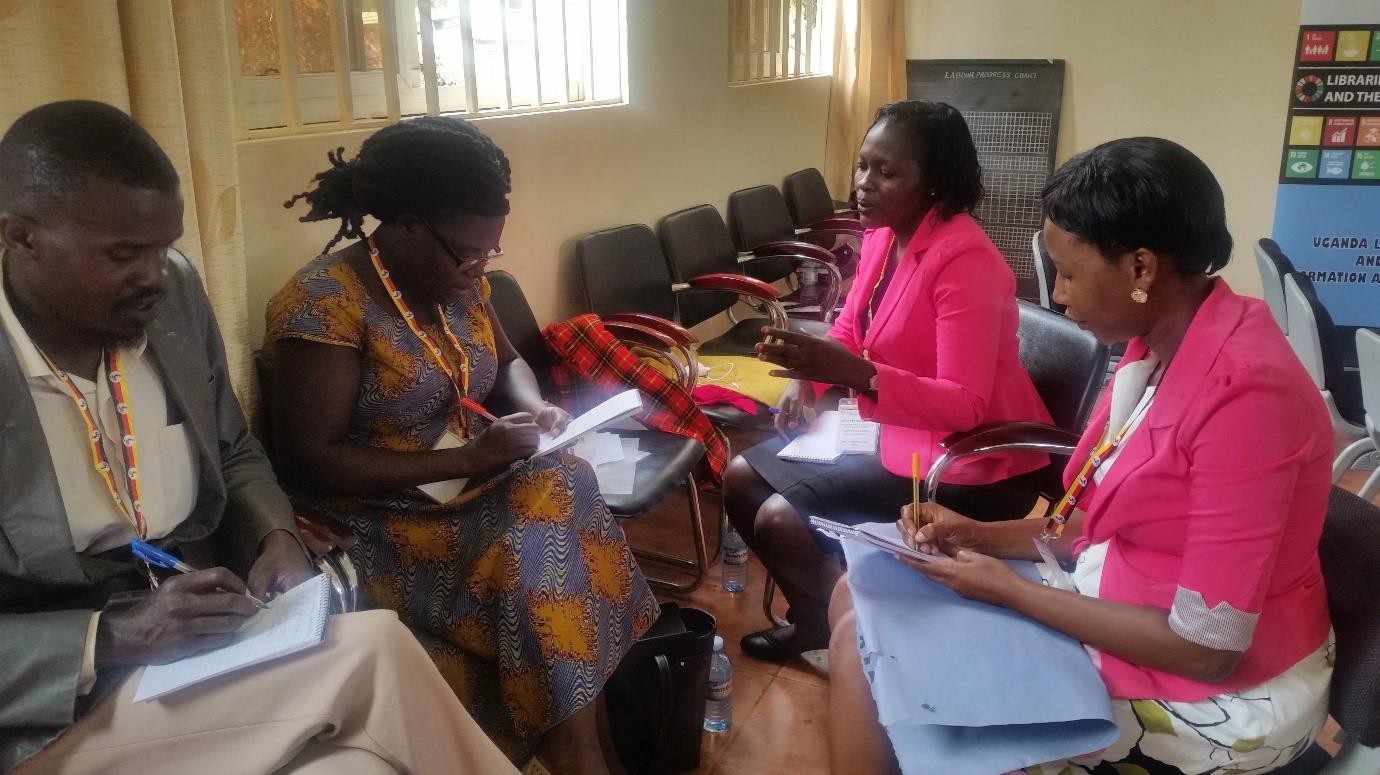
Part of the workshop participants during group work
[Photo: Justin Chisenga]
More than 100 members of the Library and Information Association of Zambia (LIAZ) on 18 July 2017 attended a one-day workshop on advocating for the Sustainable Development Goals (SDGs) in Siavonga, in the Southern Province of the country.

 “As information professionals, we need to fully understand what the SDGs are if we are to meaningfully contribute to the attainment of the 2030 Agenda for Sustainable Development”,  Ms. Velenasi Mwale Munsanje, LIAZ President, said in her welcome statement.

The practical workshop held at the Lake Safari Lodge, on the shores of the Lake Kariba, covered the following topics: introduction to the SDGs, library advocacy and the SDGs, identification of targets for advocacy initiatives, selecting an advocacy issue, developing messages, developing an advocacy strategy matrix, and monitoring and evaluation of advocacy initiatives, among others.

The participants worked in groups and developed sample advocacy plans based on the SDGs of their choice and shared their work in the plenary session.

Mr. Mark Maseko, National Information Officer from the United Nations Information Centre (UNIC), Zambia, and Mr. Charles Nonde, Librarian at UNIC, co-facilitated the workshop.

The workshop was held part of LIAZ’s 2017 Annual General Conference taking place from 18 July to 21 July 2017, on the theme: “The Role of Information Institutions and Professionals in the Attainment of the 2030 Sustainable Development Goals”.

Monday, July 10, 2017

Library Associations should embrace IFLA/AfLIA programmes

By Kenneth Mangemba

Library associations should embrace and adopt International Federation of Library Associations (IFLA) and African Library and Information Association and Institution (AfLIA) initiated programmes to enable them to increase visibility, stakeholder engagement, and to lobby and advocate for the recognition of libraries in advancing Sustainable Development Goals (SDGs). This was said by Library and Information Association of South Africa (LIASA) president and AfLIA vice president, Mr. Mandla Ntombela at the just ended Zimbabwe Library Association (ZimLA) conference held in Gweru.

LIASA president and AfLIA vice president, Mr. Mandla Ntombela at the just ended ZimLA conference held in Gweru
Addressing delegates at the conference, Mr. Ntombela spoke extensively of the IFLA Global Vision as a credible and rare opportunity that facilitates capacity building for the development and sustainability of the library communities.

The role of library associations is vital towards achieving the IFLA Global Vision and concerted efforts by associations’ leadership should prioritize embracing and implementing the initiatives that has long lasting benefit.  The LIASA president said that such initiatives are essential to advance advocacy and lobbying efforts for the library communities for recognition and improving influence in solving community challenges.

AfLIA partnered with the Global Libraries (GL) Programme of the Bill and Melinda Gates Foundation to roll out the International Network of Emerging Library Innovators (INELI) programme established to support the transformation of public libraries into engines of development and does this by supporting upcoming public librarians to develop innovative services for the benefit of their communities. Participants in the INELI initiative are expected to share the learning experience with other local librarians with the view of promoting learning and equip others with life changing skills to transform the public library network to step-up to the changing operating environment. Mrs. A. Madziwa from the Bulawayo Municipality Library system is a participant to the INELI initiative from Zimbabwe.

Participants who attended the 51th ZimLA Conference in Gweru.
The Library and Information Association of Zambia president, Mrs. Velenasi Mwale Munsanje also spoke greatly of the INELI programme as an enabler that facilitate growth for the public library system through strengthening skills of local public librarians to better serve their communities under strenuous conditions characterized by limited funding and sound infrastructure.

Mr. Ntombela said that partnership with IFLA and AfLIA reposition the library association to achieve the “Africa we want”. The major thrust emphasized by Mr. Ntombela is that IFLA’s professional programmes provide sustainable platforms for initating advocacy for libraries in society, improve services for library users, provide equitable access to information and develop the library and information profession.

In light of attaining SDGs, Mr. Ntombela said that libraries are vital institutions that should actively promote the National development plans through dynamic services that transform livelihood. He therefore gave an interesting story of Jaka Joe Informal Settlement in Pietermaritzburg, South Africa that is involved in the recycling project and challenged other library communities to formulate strategies with SDGs attainment in mind.

“Library associations have a significant role to play in strengthening partnerships with IFLA and AfLIA through developing an effective action plan for strategic positioning on government agenda”, said the AfLIA vice president. He encouraged the library associations to increase lobbying and advocacy initiatives for the development of library and information services infrastructure to achieve a positive influence from government policy regarding LIS. “Library associations should represent libraries and librarianship to the larger society and continual stakeholder engagement should be a top priority that leads to the identifying of sources of local funding for projects”, he said.

The LIASA president implored with library association leaders to be proactive in increasing influence. He said, “Library associations and institutions should enlarge their territory or mission by protecting the future of LIS workers and library users of Africa and throughout the world by developing strategies that will make the sector looks smart and cool.”

The conference keynote address by AfLIA vice president and LIASA president clearly pronounced the role of library associations in developing strong and strategic partnerships that promote influence of the library communities. Several library associations were represented at the conference with representation from Botswana, South Africa and Zambia.

The conference ended on a high note with a report from ZimLA president, Mr. Lantern Fusire highlighting on key achievements accomplished and laying out the various initiatives that the association has planned for the coming year before an elective conference in 2018.

Wednesday, July 5, 2017

LIAZ President challenges Zimbabwean library community to contribute to SDGs

By KENNETH MANGEMBA

The president of the Library and Information Association of Zambia (LIAZ), Mrs. Velenasi Mwale Munsanje has challenged Zimbabwean library community to devise strategies that would enable librarians to contribute towards achieving the United Nations developed Sustainable Development Goals (SDGs).

LIAZ Preisdent, Mrs. Velenasi Mwale Munsanje
delivering her keynote address (standing),
Session Chair, Mr. Sauel Chabikwa (middle) and
 ZimLA Vice Rresident, Mr. Shadreck Ndinde (left).
[Photo: Kenneth Mangemba]
Delivering her keynote address at the 51th Zimbabwe Library Association (ZimLA) Conference in Gweru, she said that Libraries are considered as third place, coming after homes and the workplace. “Libraries are seen as third places as people see homes as first place with the workplace coming second and if we do not devise activities that change lives libraries will lose customer base, therefore we should provide services that change lives”, she said.

“IFLA has developed advocacy toolkits to assist library associations to spearhead and engage with stakeholders on the role of libraries towards achieving SDGs”, said Mrs. Munsanje.

She said that libraries make an important contribution towards achieving SDGs, emphasizing that the local library community should devise strategies to sensitize communities on SDGs. The involvement of libraries in SDGs is an opportunity for the information institutions to remain relevant.

The keynote presentation encouraged librarians to leverage on the discourse surrounding SDGs to influence stakeholders on the value of libraries. Mrs. Munsanje noted that coordinated efforts to inform stakeholders with proper statistics that reveal the impact of libraries on citizens with regard to SDGs are necessary for the world to note the significance of library institution.

LIAZ president emphasized that the library community should move beyond building collections to formulate services that significantly impact communities they serve, for instance through advancing digital inclusion through access to ICTs and dedicate staff to help people develop new digital skills.

The 51th ZimLA conference has provided an opportunity for the information professionals to reflect on the role of libraries in advancing SGDs. The role of IFLA as an international body in providing strategic direction towards engaging stakeholders in realizing the impact of libraries is fundamental to realize the role of libraries in achieving SGDs.