Showing posts with label SCECSAL 2016. Show all posts

Thursday, June 9, 2016

SCECSAL 2016 proceedings available at US$25


Copies of the publication on display during the SCECSAL
conference in Swaziland
A limited number of copies of the book containing the papers presented at the XXIInd Standing Conference of Eastern, Central and Southern African Library and Information Associations (SCECSAL), 25-29 June 2016, Ezulwini, Swaziland, are available for purchase from the the Swaziland Library and Information Association (SWALA) at US$25 + postage.

Send requests to:

John Paul Anbu K.
Vice-Chairperson – SCECSAL 2016 LOC
Email: anbuj@uniswa.sz

A selection of the papers in the book include the following:
  • Prof. Kingo Mchombu & Dr. Chiku Mchombu, University of Namibia - “Achievement Of Digital Literacy In A Country: The Role Of African Public Libraries”
  • Neesha Ramsumar, Universal Knowledge Software (UKS), South Africa - “A Sustainable Information Environment in Africa, With Specific Reference to Cloud and Mobile Technologies”
  • Dr. Connie Bitso, University of Cape Town, South Africa - “Using Whatsapp to Sustain Functional School Libraries in Khayelitsha”
  • Esther Nderitu Imbamba and Nancy M Kimile, Maasai Mara University, Narok, Kenya. - “Assessing the Status of E-Government Development in Kenya”
  • Prof. Maria G. N. Musoke, Makerere University - “Electronic Health Initiatives Support Information Access and Use for Sustainable Development in Uganda”
  • Khosie Ndlangamandla,  Mananga Centre, Ezulwini, Swaziland &  Justin Chisenga, FAO. Rome, Italy - “Social Media in University Libraries in the SADC Region”
  • Siviwe Bangani, Sabelo Chizwina, and Mathew Moyo, North-West University, Mafikeng Campus, South Africa - “Beyond The Ivory Towers: The Experiences Of North-West University (NWU) Library Services In Community Engagement Projects”
  • Prof. Ondari-Okemwa Ezra, University of Fort Hare, South Africa - “Developing Digital Information Literacy at institutions of higher learning in sub-Saharan Africa: Opportunities and Challenges”

Tuesday, May 31, 2016

SCECSAL adopts a resolution to establish a Permanent Secretariat

Representatives of SCECSAL member Associations
who took the bold decision to establish a permanent
secretariat for SCECSAL [Photo: Justin Chisenga]
The General Assembly, the highest authority of the Standing Conference of Eastern, Central and Southern African Library and Information Associations (SCECSAL), resolved on 29 April 2016 at its XXIInd meeting in Ezulwini, Swaziland, to establish a Permanent Secretariat for SCECSAL.

The 11-member General Assembly also resolved to amend the SCECSAL constitution to pave the way for the establishment of the Permanent Secretariat and to put in place mechanisms to ensure proper coordination of the Forum’s activities, and monitoring implementation of its resolutions and decisions.

The members also resolved that the Swaziland Library and Information Association (SWALA) would henceforth temporarily host the SCECSAL Secretariat until such time as a permanent secretariat is established and becomes operational.

SCECSAL, established in 1974, has had its secretariat held and managed by member Associations on a rotational basis for a term of two years each.

Efforts to establish a permanent secretariat, as part of the need to reform SCECSAL, have been going on since the SCECSAL conference in 2000, in Windhoek, when Charles Lungu, the then Deputy University Librarian at the Copperbelt University, Kitwe, Zambia, proposed changes to “SCECSAL without altering its character” and recommend the formation of a federation of library associations in the region, which would have committees to carry out functions including those that SCECSAL has been accused of failing.

Participants at XXIInd SCECSAL in
 Ezulwini, Swaziland [Photo: Justin Chisenga]
In 2002, at the SCECSAL conference in Johannesburg, a proposal was made again to establish a permanent secretariat and was later discussed at the 2004 conference in Kampala, and in both cases the General Assembly failed to make a decision.

The 2002 and 2004 efforts were followed, in 2007, by a proposal from the Tanzania Library Association, under the guidance of Dr. Alli Mcharazo, which outlined three options for SCECSAL reforms:

  • transforming SCECSAL into a regional body with registered chapters in the member countries, with Governing Council comprising of the President, Vice President, Treasurer, and Board Members [directly elected]; 
  • forming a Regional Federation of Library, Information Associations and Institutions (RFLIAI) to resemble IFLA; and 
  • establishing a Congress of Library and Information Associations and Institutions in Eastern, Central and Southern Africa headed by an Executive Board made up of board members from each member library Association and Institutions. 
The proposal was discussed at the SCECSAL General Assembly meetings in Lusaka (2008) and Gaborone (2010) and there was no consensus on which of the three options to be adopted, and the issue disappeared from the SCECSAL agenda until April 2016 when it re-surfaced.

Considering the failure, on several occasions, in the past by the SCECSAL General Assembly to radically reform SCECSAL, the 29 April 2016 resolution to work towards establishing a Permanent Secretariat is a very bold move.

However, unless things move at a relatively faster pace than has been the case in the past, and the Presidents and Chairpersons of the SCECSAL member Associations act in good faith during the process of setting up and choosing the member Association to host the Permanent Secretariat, SWALA might as well start preparing to host temporarily the permanent Secretariat for SCECSAL for a long time.
---
Visit the SCECSAL website to download a copy of the XXII SCECSAL Resolutions.

Thursday, May 5, 2016

Bravo SWALA for organizing such a wonderful showpiece – SCECSAL 2016!

By Erick Nelson Haumba
Kampala, Uganda

If anything has to be discussed about SCECSAL 2016, it has to be my personal experience and feel of the just concluded conference in eZulwini, Swaziland, held from 25 to 29 April. Under the theme “Digital transformation and the changing role of libraries and information centre’s in the sustainable development of Africa”, the Sub-Saharan region and the African continent as a whole experienced one of the best library and information service (LIS) fraternity showpieces of all times.

Eric Nelson Haumba presenting a paper at SCECSAL 2016
The approach and focus during the conference days was broad, enriching and focused on the changing role of libraries in the sustainable development of our continent which was spot-on with our expectations. In the academic setting, it’s extremely hard to disagree that the quality of the papers and conference proceedings was tremendously high. You could not hear of any corridor talk expressing any sort of dissatisfaction. Thanks to the efforts of the editorial team and international review committee.

As an upcoming professional, my goal is to always attend a conference where I simply have to learn from. I always want to be a sponge and soak up as much information as I possibly can. And SCECSAL 2016 Conference offered me more than that. From the keynote speakers to the invited guests who opened the conference, a lot was leant from them.  After attending a few sessions, it was rock clear to me that I wasn’t going to disappoint myself. I could sometimes pick the sessions to attend either based on the topic or based on who was actually presenting. This gave me an opportunity to hang back after the session was over and have a conversation with the presenters and fellow attendees who were really smart people.

It was an interesting moment to meet with the continent’s best, the stalwarts and peers from the profession. That was my time to take advantage of their knowledge.  I took notes and soaked it all in. About the culture of the people, it’s another matter that needs to be mentioned. From the hosts to all the countries represented, it was amazing to witness the cultural diversities at the cultural dinner. The warmth and hospitality of the people of Swaziland was beyond imagination. The performances were superlative, from the delegates as well as the invited performers. I could hardly see any member of the SWALA team wearing out. Even after the tiresome seven days, John Paul Anbu and his team were looking fresh, robust and full of smiles. I commend you for that.

The best part of attending conferences is establishing friendships and connections with other
Traditional dancers at the Cultural Evening
conference attendees – many of them our fellow peers from across the world. Not only did I have the opportunity to learn from experts at the conference, I also made connections with them and synergized with other conference delegates. The conference presented numerous opportunities to mingle with conference speakers, panelists, delegates and corporate sponsors. I could feel it as many of them were more than happy to stay connected with us during and after the conference.

As you may have noted, there are many advantages to attending conferences but my experience at SCECSAL 2016 only solidifies for me that attending conferences can make you a better person from either the knowledge you learn, the connections you make, or all of the above! To all the delegates, just take a minute to commend SWALA and LOC for the immaculate work by commenting on this blog.

From me, Bravo SWALA for organizing such a wonderful showpiece! Long Live SCECSAL. We welcome you to Uganda in 2018.

For God and My Country

Saturday, April 30, 2016

SCECSAL unveils new logo

The new SCECSAL logo
The Director of the Swaziland National Library Service (SNLS), Mrs Joy Dlamini, on Friday, 29 April, unveiled the new logo for the Standing Conference of Eastern Central and Southern African Library and Information Associations (SCECSAL) during the XXIInd session of SCECAL at the Royal Swazi Sun in eZulwini

The new logo consists of a map of Africa with the three SCECSAL regions – Eastern, Central and Southern Africa shaded in Green, Yellow (Gold) and Blue respectively, and the remaining part of the map (non-SCECSAL region) shaded in Grayscale; the acronym, made up of the letters SCECSAL, in Blue; and the full-name of the organization - Standing Conference of Eastern, Central and Southern African Library and Information Associations - in Green.

The decision to re-brand SCECSAL was initiated in July 2012 through discussions
Mrs Dlamini handing flash drives containing files
of the new SCECSAL logo to the representatives of
SCECSAL member Associations
with the Presidents and/or Chairpersons of the SCECSAL member associations. The final design was created from a consolidation of ideas from the representatives of the SCECSAL member Library and Information Associations following a survey and discussions held in 2013, and inputs from the SCECSAL General Assembly meeting in Malawi in 2014.

Member Associations were each handed a flash drive containing digital files (.eps, .jpg and .gif) of the new logo, and henceforth are expected to ensure that events related to SCECSAL carry the new logo.

Friday, April 29, 2016

SCECSAL 2018 heads to Uganda

The SCECSAL General Assembly on Friday, 29 April, in eZulwini, Swaziland, endorsed the Uganda Library and Information Association (ULIA)'s bid to host the XXIIIrd Standing Conference of Eastern Central and Southern African Library and Information Associations in April 2018.

The Nambian Library and Information Workers Association (NIWA) will be on standby to ULIA and thus the favourite to host SCECSAL in 2020.


ULIA will be hosting the conference for the third time, having done so in 1990 and 2004.

Sights from the SCECSAL 2016 Cultural Evening

Each SCECSAL Cultural Evening event is unique and the one held on 27 April 2016 at the University of Swaziland’s Ligcabho Lemaswati Sports Emporium was no different. The event was beautiful, colourful and entertaining. Below is a selection of some photos from the event.

Some participants from South Africa

Prof. Rocky Relebipi-Simela (L) and
Jennefer Nicholson (R)
Team from Namibia

Team from Zambia

Part of the team from Botswana
Prof. Kigongo-Bukenya from Uganda
Uganda on the dance floor
Participants from Botswana dancing in style


Thursday, April 28, 2016

Lone participant from Lesotho scoops top award at SCECSAL 2016 Cultural Evening

Ms Masechele Qoola (R) receiving the trophy from
Ms Joy Dlamini, Director, Swaziland National
Library Services
A lone participant from Lesotho, Ms Masechele Qoola, defied all odds when she scooped the top award at the colourful SCECSAL Cultural Evening dance competition held at the University of Swaziland’s Ligcabho Lemaswati Sports Emporium on Wednesday evening.

Donned in a Sesotho traditional dress and a Sesotho blanket covering her shoulders, Ms Qoola captivated the audience with her graceful dance movements and danced her way to victory with 75 points.

The hosts, Swaziland, put up a colourful display of their traditional attire and well-choreographed moves and came in second position with 70 points.

The final standings were as follows:

1st Position – Lesotho (75pts)
2nd Position – Swaziland (70pts)
3rd Position – Botswana (68pts)
4th Position – Malawi (66pts)
5th Position – Uganda (65.5pts)
6th Position – Tanzania (65pts)
7th Position – Namibia and South Africa (64pts each))
8th Position – Zambia and Zimbabwe (62pts each)

Kenya failed to show up for the dance competition.

The two judges for the evening, Ms Sibongile Mamba and Mr. Mathokoza Sibiya, took into account the songs used, choreography, expression, and costume worn by the dancers to arrive at the rankings of the participants.

Dancers from from Malawi
Library and information professionals from Botswana improved on their past performances, and their combination of dance, poetry and ululations received loud applause from the participants.

Malawi were original in their choice of song and dance, and the seriousness they showed in their performance earned them many supporters among the participants.

The SCECSAL Cultural Evening, a major feature of each SCECSAL conference, provides conference participants with an opportunity to showcase their traditional dancing skills in a relaxed environment.

Wednesday, April 27, 2016

How do you increase accessibility to research with a “closed access” institutional repository?

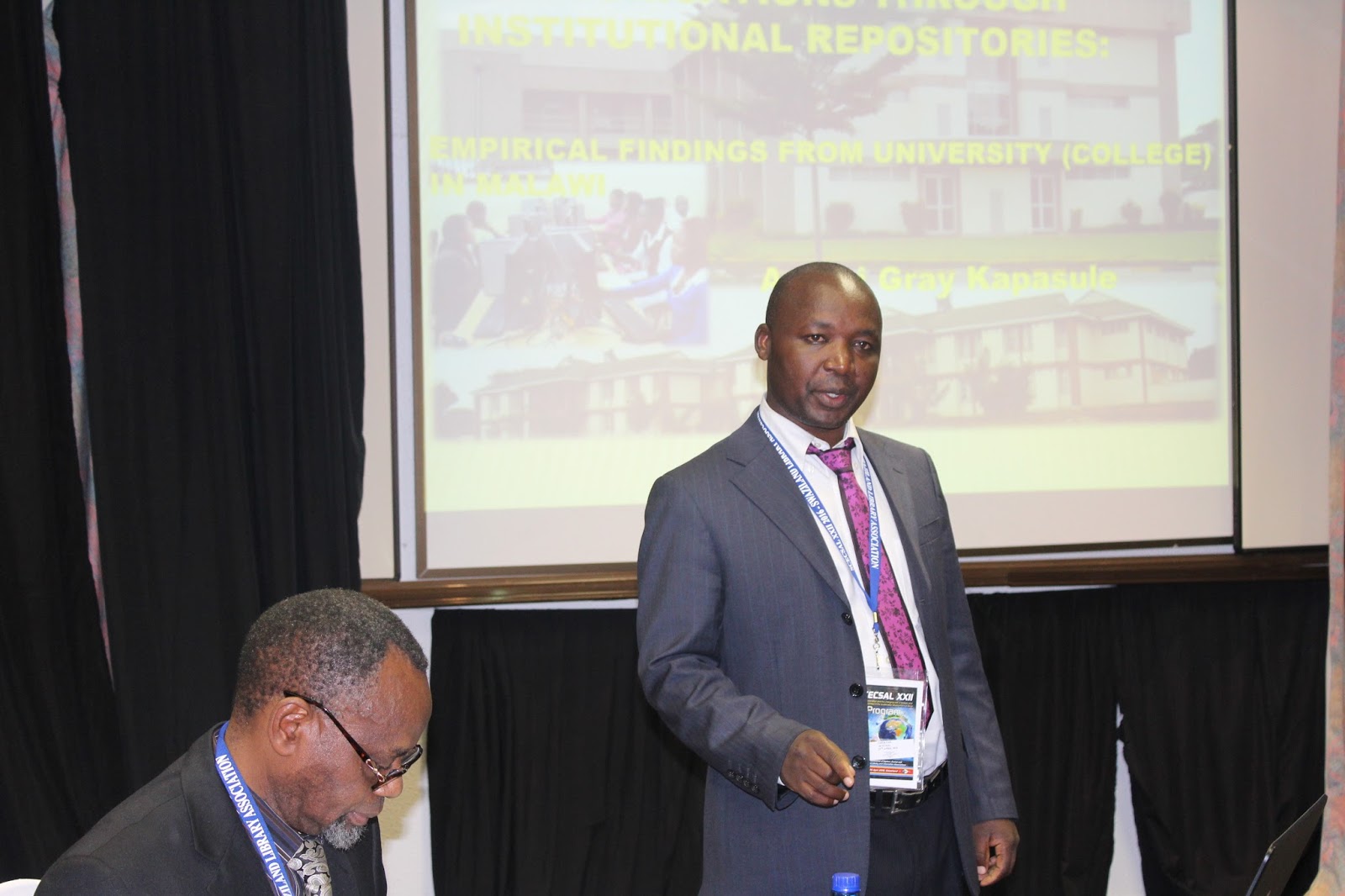
Mr. Amoni Gray Kapasule
presenting the paper
The second day of SCECSAL 2016 included a presentation of the paper - Revolutionizing Scholarly Communications Through Institutional Repositories: Empirical Findings from a University (college) in Malawi by Amoni Gray Kapasule & Winner Chawinga - which highlighted two key challenges facing most librarians in Africa when the embark on developing institutional repositories (IRs) as modes of providing access to their institutions’ knowledge resources. Challenges related to lack of support from or the unwillingness of the the researchers/lecturers to contribute content to the IRs, and the absence of an enabling institutional environment to facilitate opening access to research.

The paper, based on a study focusing on Kamuzu College of Nursing (KCN) Library’s institutional repository, indicated that among the reasons for establishing the IR by KCN were to increase accessibility to research outputs and to promote image of College through online visibility.

The findings of the study tell a different story and shows that it will be difficult, if not impossible, for KCN to achieve the above two objectives.

While 81% of the lecturers that took part in the study indicated that one major benefit of IRs is that they help to communicate research results, only 7% were contributing to the IR. Furthermore, the IR is only accessible on the local intranet.

How do you increase accessibility to research output when researchers/lecturers who generate the content are not contributing to the IR? How can you also enhance the image of the institution through online visibility when IR is not available to the wider community beyond the confines of the institution?

KCN Library is not the only library facing these challenges. There are many other libraries in Africa that are in the same boat.

Setting up institutional repositories to provide access to research outputs in most libraries in Africa is more of a fad than initiatives aimed at achieving objectives of opening access to the continent’s research. It is a question of our neighbours are have setup an IR and so we should also have one otherwise we will be seen as being lagging behind the trend. Genuine conviction to provide access to research outputs of the institutions, worse still to open access, is missing in most institutions.

Reluctance by the learned researchers/lecturers to contribute content to IR
Some of the challenges faced by KCN Library
initiatives is just one of the major challenge besieging librarians who embark on developing IRs. Absence of an enabling environment (national and institutional policies favourable to sharing research outputs with the outside world, institutional guidelines, and incentives to promote sharing of research), and the never ending technical challenges (lack of access to computers, poor internet connectivity in institutions even when better connectivity is available in the countries) impact on initiatives to open access to research.

If IR initiatives are to succeed in Africa, universities or institutions “should launch OA institutional repositories (IRs) and adopt effective policies to fill them with their research output. That is, they should actually provide OA to their research output, not just wish for it, request it, encourage it, settle for ineffective policies to provide it, or sign statements calling for it elsewhere

Monday, April 25, 2016

Her Royal Highness Princess Sikhanyiso opens SCECSAL 2016 conference

Her Royal Highness Princess Sikhanyiso delivering her remarks
Her Royal Highness Princess Sikhanyiso, who is also the patron of the Swaziland Library Association, has officially opened the XXIInd biennial Standing Conference for Eastern, Central and Southern African Library and Information Associations (SCECSAL), which this year is taking place at the Royal Swazi Sun, in the fast developing town of eZulwini, Swaziland.

In her opening speech, Princess Sikhanyiso urged libraries and librarians in the SCECSAL region to adopt modern information and communication technologies to facilitate digital transformation.

“A massive library with no computers or Internet in this modern age is likely to be as quiet as a graveyard”, Princess Sikhanyiso told participants at the opening session. “How do we keep libraries useful and relevant in the 21st Century?”, asked the Princess.

Under the theme - "Digital Transformation and the Changing Role of Libraries and Information Centres in the Sustainable Development of Africa", speakers and participants at the conference will deliberate on various sub-themes including emerging technologies and their role (Big data, cloud computing, mobile applications, semantic web, text mining, next generation web services etc.); e-governance, e-agriculture, e-health – their roles and impact in development; and the role of social media, social networks and networked information on development.

The papers to be presented at SCECSAL 2016 include:

  • Prof. Ondari-Okemwa Ezra - Developing Digital Information Literacy at institutions of higher learning in sub-Saharan Africa: Opportunities and Challenges.
  • Dr. Sarah Kaddu & Eric Nelson Haumba - Promoting ICT based agricultural knowledge management for increased production by smallholder rural farmers in Uganda: A case of Communication and Information Technology for Agriculture and Rural Development (CITARD), Butaleja.
  • Clement Anubi Fulano - An assessment of the Malawi Broadcasting Corporation (MBC) Radio in the dissemination of agricultural information: a case study of Balaka District.
  • Khosie Ndlangamandla & Justin Chisenga - Social media in university libraries in the SADC Region.
  • Dr. Connie Bitso - Using WhatsApp to sustain functional school libraries in Khayelitsha.
  • Imbamba Esther Nderitu & Nancy M Kimile - Assessing the status of e-Government development in Kenya.
  • Lantern Rangarirai Fusire & Similo Ngwenya - Promoting innovations from indigenous knowledge in selected communities in Zimbabwe.
  • Hamis Lack Abdullah, Lusayo Mwabumba & Winner Chawinga - Diffusion of information/knowledge for growing forest herbs amongst traditional healers: a case of traditional healers at Ekwendeni, Malawi.
Her Royal Highness Princess Sikhanyiso with participants at the conference
Although the SCECSAL region covers 26 countries in Eastern, Central and Southern Africa, most participants are expected to come from 11 countries in the region – Botswana, Kenya, Lesotho, Malawi, Namibia, South Africa, Swaziland, Tanzania, Uganda, Zambia and Zimbabwe.

The biennial conference is hosted by SCECSAL member Library and Information Associations, and the Swaziland Library Association (SWALA) is hosting the SCECSAL for the second time, 28 years after hosting the conference in 1988.

On Friday, 29 April, the SCECSAL General Assembly will announce the member Association to host the conference in April 2018 and unveil a new logo for SCECSAL.

Wednesday, March 9, 2016

SCECSAL 2016 - Highly discounted registration fee for students announced


Due to a constant demand from students for a discounted registration fee, SCECSAL Local Organising Committee has introduced a new registration category for Non-Salaried Students. Any student who is currently not employed and would like to attend the conference can use this highly discounted registration of US$200. For more details go to http://scecsal.eu.pn/reg.html or write to scecsal2016@gmail.com

Wednesday, June 3, 2015

SCECSAL XXII (2016) Call for papers

Swaziland Library Association (SWALA) will host the Twenty-Second Standing Conference of Eastern, Central and Southern Africa Library and Information Associations (SCECSAL XXII), 25-29 April 2016 at the Royal Swazi Sun, eZulwini, Swaziland.

SWALA invites the submission of abstracts to be considered for papers to be presented at SCECSAL XXII.

Abstracts with approximately 300 words addressing the theme and the sub-themes and written in English should have the following details.
  1. Title of the Abstract
  2. Name(s) of the Authors with official titles or professional role,
  3. Author’s affiliated institution and
  4. Keywords (minimum of three)
Conference Theme:

Digital transformation and the changing role of libraries and lnformation centres in the sustainable development of Africa

Sub Themes:
  • Emerging technologies and their Role (Big data, Cloud computing, Mobile applications, Semantic web, Text mining, Next generation web services etc.)
  • Issues of Digital Rights Management and Intellectual Property Rights
  • E – infrastructure development for sustainable development
  • E – governance, E- Agriculture, E-Health – their roles and impact
  • Indigenous Knowledge and digital transformations
  • Knowledge Management and Resource Discovery Tools
  • Digital preservation of Cultural Heritage and cultural archives
  • Quality assurance and best practices in digital scholarship
  • Role of Social Media, social networks and Networked information
  • Library Advocacy
Guidelines for Abstract Proposals:

Abstracts with approximately 300 words, must address the sub-themes and written in English should have the following details. 1) Title of the Abstract, 2) Name(s) of the Authors with official titles or professional role, 3) Author’s affiliated institution and 4) Keywords (minimum of three).

Guidelines for paper preparation:

The guidelines for submitting papers once your abstracts are ready is provided as a downloadable document. Click here to access the guidelines for submitting papers:

Please email your abstracts to scecsal2016@gmail.com or anbuj@uniswa.sz or fmkhonta@uniswa.sz

Important Dates:

Submission of Abstracts : 30th September 2015
Notification of Acceptance: 30th November 2015
Submission of Full paper: 31st January 2016
Submission of presentation slides: 31st March 2016
 
More Information & Related Websites


Sunday, August 3, 2014

SWALA to host SCECSAL XXII conference in 2016

SWALA delegates at SCECSAL 2014
On Friday, in Lilongwe, Malawi, the SCECSAL 2014 General Assembly endorsed, by an unanimous decision, Swaziland Library Association (SWALA)’s bid to host the Twenty-second SCECSAL conference in 2016.

The Uganda Library and Information Association (ULIA) will be on standby to host the conference in the event that SWALA fails to do so. Article 6, Section 6.6 of the SCECSAL constitution also gives ULIA an automatic right to host SCECSAL XXIII in 2018, provided the Association confirms in writing its willingness to host the conference at least 3 months before SCECSAL XXII in Swaziland.